By Dr. Chris Cormier, DC
Here is something I should probably keep to myself.
If you tell me I need something, my instinct is to take a lot of it. Not the amount on the label. More than the amount on the label, because if some is good then surely more is better, and I would like the benefit sooner rather than later please.
I have spent nearly three decades telling people to be careful about exactly this. I am very good at that conversation. I am good at it because I am having it with myself at the same time, and have been for most of those three decades, with mixed results.
The cupboard
I could not tell you what I have spent on vitamins and supplements over the years. I genuinely could not produce the figure, and I am not sure I want to.
It was always in pursuit of something reasonable — finding the best version, the better-absorbed form, the one from the manufacturer who actually tests. That is not a foolish project. It is most of my professional life. But the practical result, for a long stretch, was a cupboard that filled faster than it emptied, and a wife who would open it, look at it, look at me, and say nothing in a way that said a great deal.
She was right. I want to be clear about that before anybody mistakes this for a fond anecdote about a quirky habit. She was right and I was taking too many supplements.
Why the instinct is not stupid
I have thought about where it comes from, because I see it in other people constantly and it does not look like carelessness. It looks like enthusiasm pointed at a faulty model.
The model most of us carry is a line. More of a good thing produces more of the good result, and the only limit is what you can afford. That model works for plenty of things in life. It does not work for nutrients, and almost nothing in the way supplements are sold will tell you so.
The actual shape is a range. Below it you have a problem. Inside it you are fine. Above it you have a different problem, and the second problem is frequently harder to notice than the first, because it does not announce itself as a symptom. It just sits there.
Nobody designs a label to tell you that your enthusiasm is the risk. The label is written for somebody who might not take enough.
What it actually cost
Money, obviously, and more than I would like on the record.
But the cost I did not see at the time was different. When you are taking fifteen things, you cannot tell what any of them are doing. You have removed your own ability to learn anything. Start four supplements in a month and feel better, and you have gained a pleasant feeling and no information whatsoever — which is a bad trade for somebody whose job is working out what helps people.
There is a particular frustration in that which took me a while to name. I was spending money in order to find out what worked, and the way I was spending it made finding out impossible. Every new purchase made the picture muddier than the one before, so the more seriously I took the question, the less able I became to answer it.
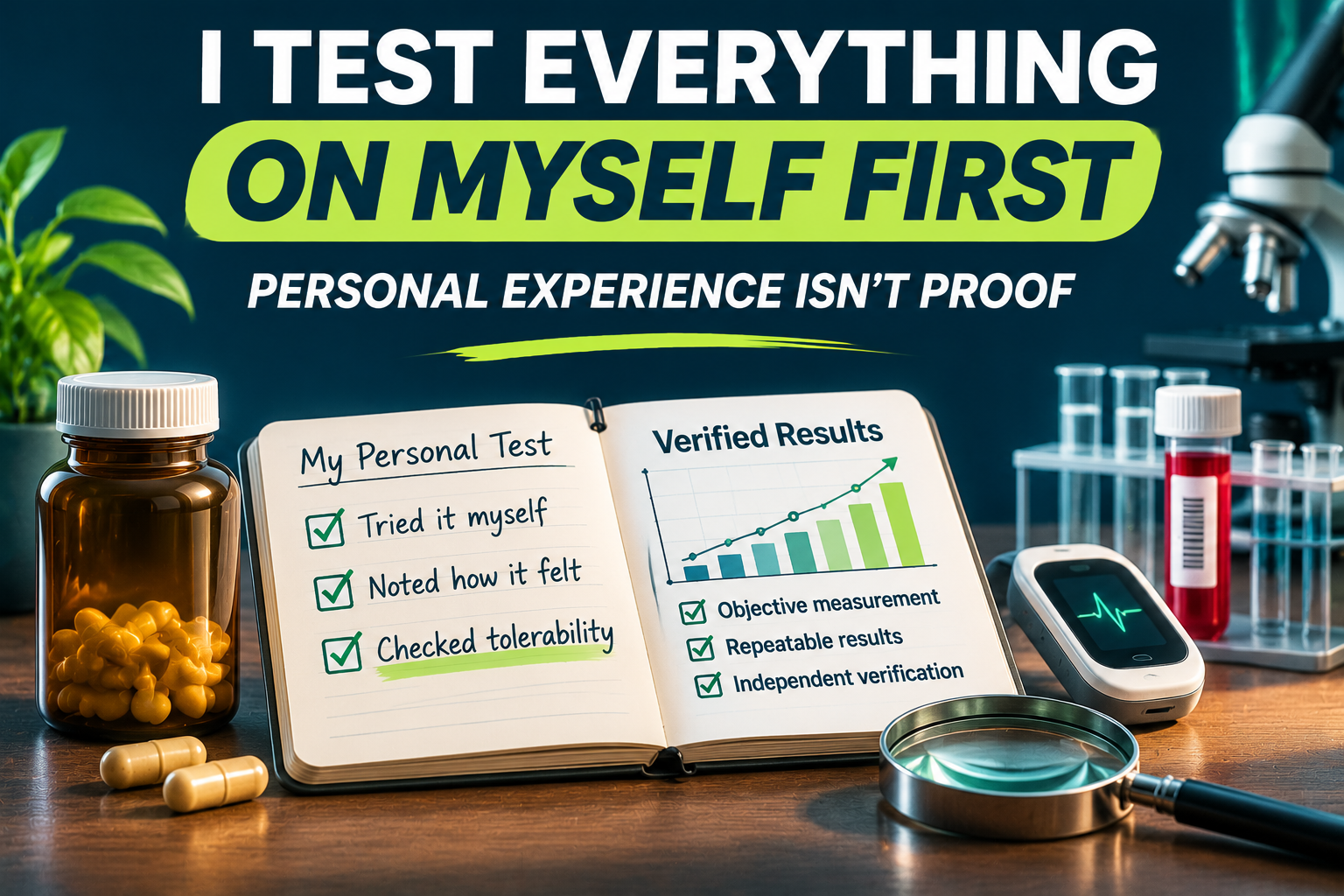
I wrote about the narrower version of that problem, and the limits of judging anything by how you feel on it, in I test everything on myself first. This is the broader version. That essay was about being a poor observer. This one is about being an eager customer, which is worse, because the eagerness does the choosing before the observing even starts.
The thing I eventually understood
It is a fuel tank, not a bank account.
You want the tanks reasonably full. You do not get credit for overfilling them, and you cannot save the surplus for a week when you are busy. The body holds most of these things inside fairly narrow ranges and clears what it does not need, which is an elegant arrangement and a complete waste of the extra money.
And one of them does not even do that. Iron is the exception that taught me the most, because the body regulates how much it absorbs but has no proper route for getting rid of what it already holds — which EBOO Prime set out in should you take iron. I had been treating every bottle in that cupboard as though the surplus simply went away. For one of them, it does not.
Why this makes me better at the job
People sometimes expect a confession like this to undermine the advice. I think it does the opposite, and I would like to explain why rather than just assert it.
When somebody sits down opposite me and starts explaining their stack — slightly too fast, slightly defensive, with that particular brightness people get when they are describing a thing they have invested in — I am not making a judgement. I am recognising something. I know what that enthusiasm feels like from the inside, including the part where you already half suspect it has got away from you and would rather not be the one to say so.
That recognition is worth more in the room than any amount of disapproval. Nobody has ever reduced their supplements because a doctor looked disappointed. I wrote about those appointments from the other side of the desk in the patients who arrive with a list.
The advice I give about taking too many supplements is not advice I arrived at by being temperate. I arrived at it expensively, over years, and somebody watched me do it.
The appointment I think about
A man came in some years ago and laid out what he was taking. Not a list — he had brought the actual bottles, in a carrier bag, and he set them on the desk one at a time while explaining each one.
About two thirds of the way through, I realised I was preparing a small speech. The one about being careful, about not needing all of this, about how the body is not a shopping list. I had given it many times and I was good at it.
And then I noticed that four of the things on his desk were in my house.
I did not give the speech. I asked him instead what he was hoping each one would do, and we went through them together, and somewhere around the fifth bottle he said — without my prompting it — that he was not sure about that one. Then he said it again about the next. He got there himself in about ten minutes, which is roughly ten minutes faster than my speech has ever got anybody anywhere.
I went home and looked at my own cupboard properly for the first time in years. That is the appointment that changed how I run appointments, and he has no idea he did it.
What I do now
These are rules I need. I am not handing them out as a prescription, and your version will look different.
- One new thing at a time, for at least six weeks. If I cannot wait six weeks, that is information about me rather than about the supplement.
- A reason written down before I buy. If the reason is “it seems like a good idea”, I have learned to read that as “I want to buy something”.
- Totals, not bottles. The same nutrient turns up in several products and nobody adds them up — which is the whole argument of the clinic’s page on vitamin B6 toxicity and nerve symptoms.
- Test where testing actually works, and accept where it does not. For iron it genuinely tells you something; for magnesium the standard blood test largely does not, as the clinic explains in magnesium forms.
- Food first, every time, because it is the only part of this I have never regretted spending money on.
And the one I still break
Dosing. If a label says two and I am feeling enthusiastic, the hand reaches for three before the brain catches up.
I notice it now, which is not the same as not doing it. Thirty years of knowing better has made me faster at recognising the moment, and it has not removed the instinct, and I have stopped expecting it to. What has actually helped is boring and structural: I buy less, so there is less within reach to be enthusiastic about.
That is the only honest advice I have on this. Not willpower. Fewer things in the cupboard.
Where this leaves me
I still believe supplements can be useful. I still take some. I have simply stopped believing that my own enthusiasm counts as evidence that a thing is working, which is a lesson I seem to need to learn repeatedly in slightly different costumes — I wrote about another fitting of it in I’ve stopped being impressed by good genes.
And if you are standing in front of your own cupboard wondering whether it has got away from you: it probably has, that is extremely common, and you are being told so by a man who had to be shown his own.
Body Charger has the practical version of sorting it out, including the one category almost everybody buys without needing, in do you need electrolytes.
Questions people ask me about this
How many supplements is too many?
There is no number, and anyone who gives you one is guessing. The more useful test is whether you could say, for each bottle, what it is for and how you would know if it were working. If several fail that test, you are probably taking too many supplements regardless of what the count is.
If a supplement is good for me, is more of it better?
Generally no. Most nutrients work across a range rather than along a line — too little is a problem, inside the range is fine, and above it you get a different problem that is often harder to notice. A few, iron in particular, accumulate rather than clearing.
How do I cut down without losing something that was helping?
Slowly and one at a time, the same way you should have added them. Remove one, wait several weeks, notice whether anything changes. It is tedious and it is the only method that produces an answer. Anything prescribed stays until the person who prescribed it says otherwise.
More essays
I write about what practice teaches you, as opposed to what you expected it to. The rest is at drchriscormier.com/writing, there is more about me at about, and you can reach me through contact.
Spark your cells to optimal longevity.
— Dr. Chris Cormier, DC