By Dr. Chris Cormier, DC
Every family has a health person. It is not a job anybody applies for. It is the one who gets the photograph of the rash at ten at night, the one asked whether a tablet can be taken with another tablet, the one who is expected to have an opinion about somebody’s knee.
In mine, that is me, and for twenty-odd years it has been a role I have enjoyed more than I let on.
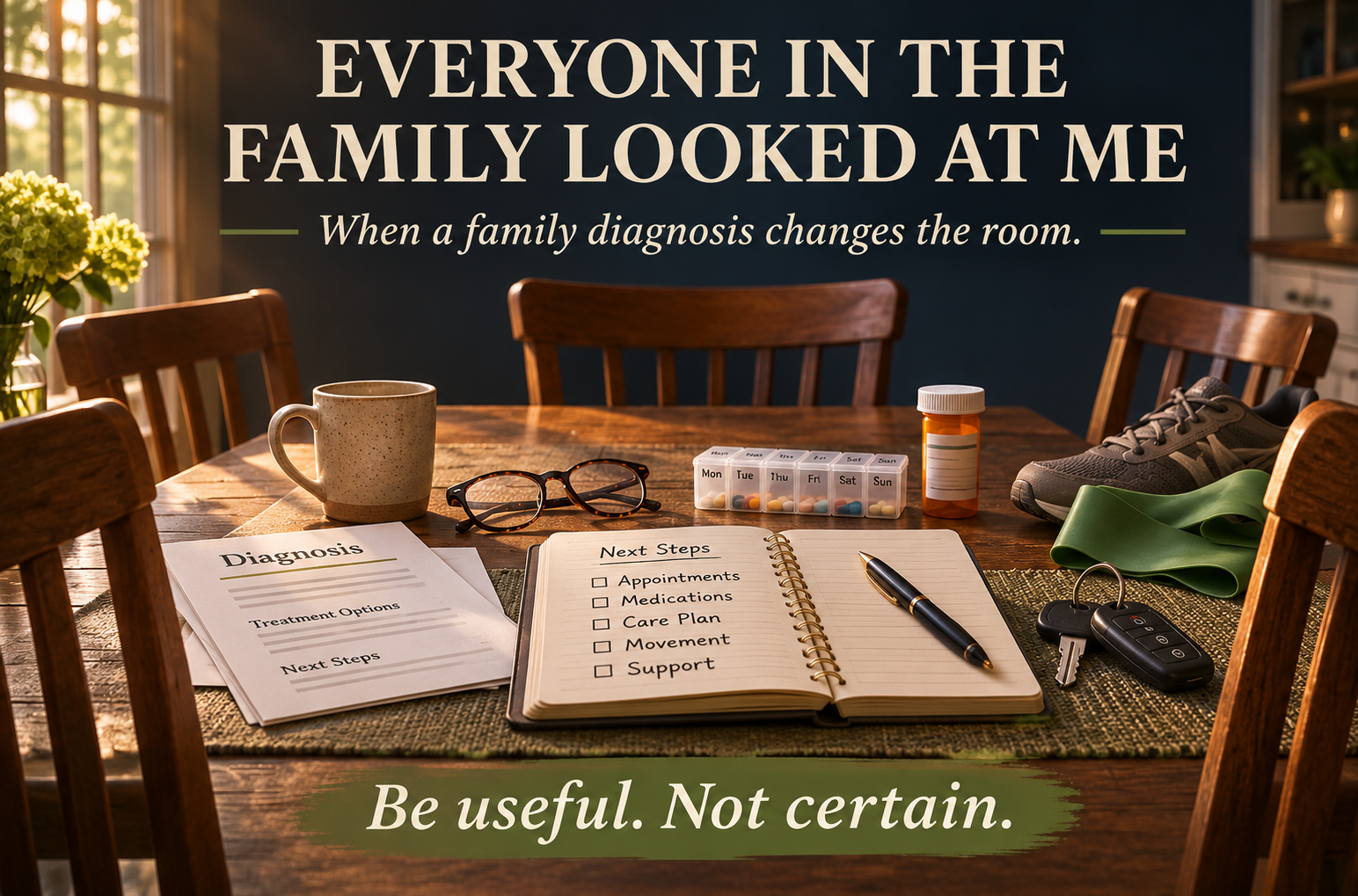
Then somebody in my family was given a diagnosis of a progressive neurological condition, and in the quiet after the news everyone in the room looked at me.
I want to write about what I said, because I think about it more than almost anything else in my working life.
What happens in a family when a family member is diagnosed with something that will not go away is, I have come to think, a fairly universal sequence. Somebody becomes the researcher. Somebody becomes the one who copes by organising. And somebody is handed the job of knowing, whether or not they do.
What they were actually asking
They were not asking for information. Information was already everywhere, most of it contradictory, a good deal of it frightening, and at least some of it written by people selling something.
They were asking a much simpler question, which was: is there something we can do.
And underneath that, the real one, the one nobody says out loud: tell us this does not have to happen.
I knew exactly what the honest answer was. I also knew that I was the person they had chosen to hear it from, which is a different thing from being the person qualified to give it.
The sentence
What I said was that my work could not change the course of this condition.
It took me longer than that, and I said it badly, and I remember the shape of the silence afterwards. But that was the content, and it was the only thing I could say that was both true and mine to say.
I have delivered versions of that sentence to patients for two decades. I thought I had got reasonably good at it. I had not, as it turns out, got good at it at all — I had got good at delivering it inside a professional frame, in a room designed for it, to somebody who came in expecting a clinician.
Say it at a kitchen table to people who love you, about somebody you all love, and there is no frame at all. There is just you, saying a true thing that nobody wanted.
The version of me that could have said something else
Here is the part I would rather not write, and the reason I am writing any of this.
There was an alternative available to me in that kitchen. I could feel it sitting there. I could have said that we would look at the whole picture, that the body has remarkable capacities, that there are things worth trying, that nobody really knows. Every one of those phrases is technically defensible. Strung together in a frightened room they say something they do not literally say, and everybody present would have heard the thing they wanted to hear.
I would not have had to lie once. That is what makes it dangerous.
Hope is the easiest thing in the world to sell to frightened people, which is precisely why they are the people you must not sell it to.
I have watched families spend money they did not have on certainty that nobody could provide. Not on anything fraudulent — on sincere, warm, well-reviewed practitioners who simply did not say the word no when it was the accurate word. The cost is rarely only money. It is the months spent chasing, and the specific exhaustion of hoping on a schedule set by somebody else.
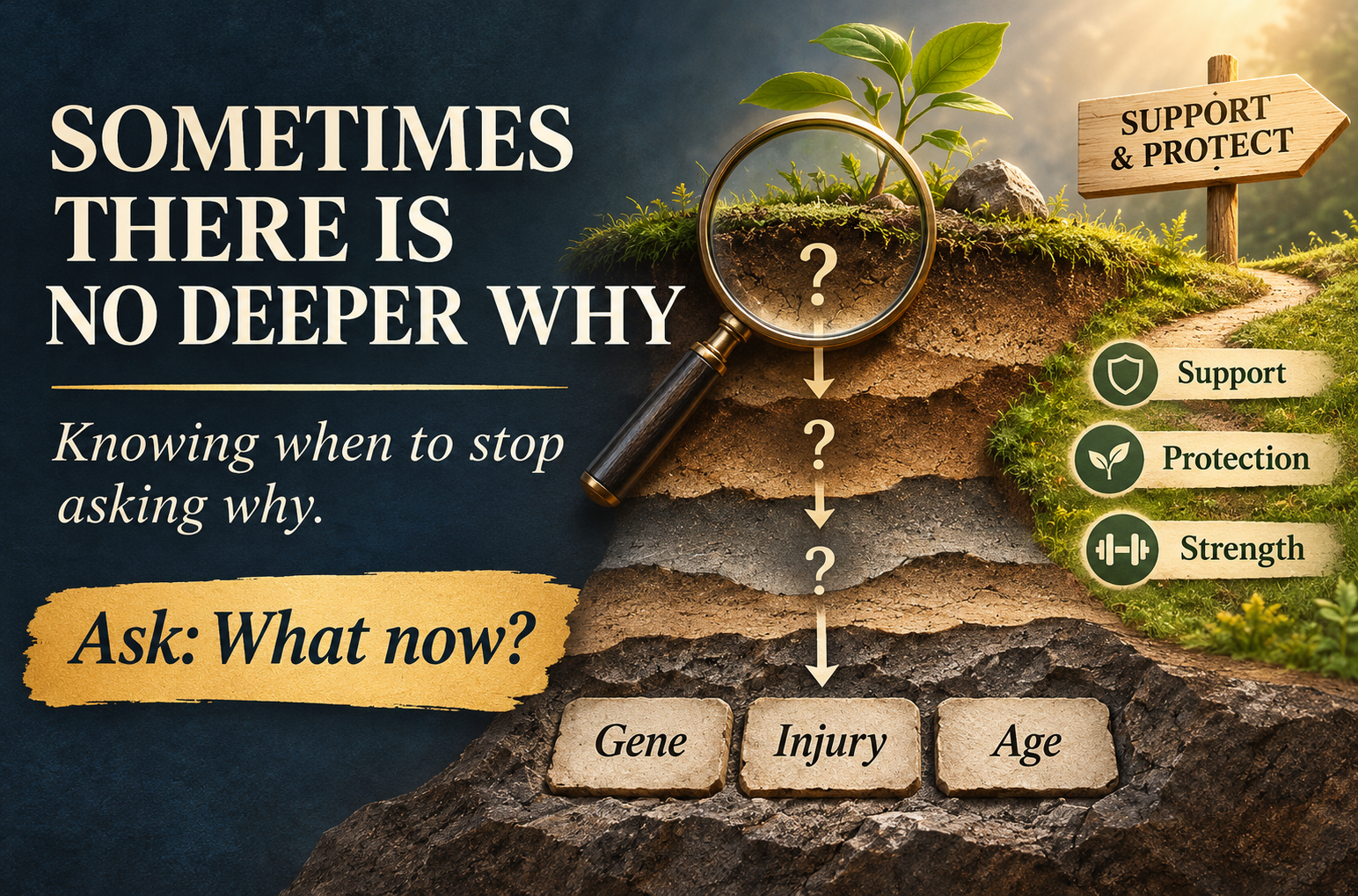
I have written before about how badly people want a story that explains their illness, in sometimes there is no deeper why. This is the commercial cousin of that. The demand is real, somebody will always meet it, and the only question is whether it will be you.
Then I got it wrong anyway
Having been honest, I proceeded to be useless in an entirely different way.
I went into clinician mode. I read everything. I arrived with printouts. I had opinions about the appointment schedule. I turned a person into a project, and I did it quickly and with total conviction that I was helping.
He did not want a project. He wanted to talk about the football and be asked how he was in the ordinary way that does not require an answer. What I had done, without noticing, was make every single interaction between us about the diagnosis — which meant that I had become one more place where he could not get away from it.
Nobody told me this. I worked it out from how the conversations went, which is to say from how quickly they ended.
It is a close relative of something I see constantly at work, which I wrote about in the patient who apologised for being ill. People with a serious diagnosis spend an astonishing amount of energy managing everyone else’s feelings about it. I had added myself to the list of people he had to manage.
What there actually was
Having cleared away what I could not do, something was left, and it was more than I expected.
Movement, which is not a consolation prize
For most progressive neurological conditions, exercise is recommended early and throughout, and it is recommended on the basis of real evidence rather than general encouragement. It is one of the few things in the whole picture that is both genuinely supported and entirely within reach.
I am careful about how I say this, because there is a way of saying it that turns into a burden — as though a person’s trajectory were their own fault for not trying hard enough. It is not, and anybody implying otherwise should be shown the door. But a specialist-set programme, done most days, with somebody to do it alongside you, is a real thing to offer when you badly want something real to offer. Balance work in particular has an unusually strong evidence base, which I have written about on our at-home site as how to improve balance at home.
Being the person who writes things down
Nobody takes in a consultation about their own progressive diagnosis. The second person in the room, with a notebook and no emotional stake in the next ninety seconds, is worth more than any opinion I have ever had.
Driving. Parking. Sitting in waiting rooms. Knowing the name of the medication and the actual schedule. Asking the question he was too polite to ask. This is unglamorous and it is the bulk of what help consists of.
Not flinching
Continuing to behave like somebody who knows him, rather than somebody monitoring him. Letting a conversation be about nothing. Not scanning his hands every time he picked up a cup — and I did scan, at first, and he noticed, because people always notice.
The part nobody prepares you for
Everything written for families concerns the diagnosis or the end. Almost nothing concerns the middle, and the middle is where nearly all of the time is.
The middle is years. It contains holidays and arguments and birthdays and long stretches where very little changes and the whole thing recedes into the background of an ordinary life. People keep their sense of humour. They keep being irritating in the specific ways they were always irritating. They are not, during those years, primarily ill — they are primarily themselves, with something going on.
I was braced for a decline and what I got was a life. I wish somebody had told me that, so I had spent less of the early part waiting.
If you take one thing from this: when a family member is diagnosed, the temptation is to reorganise everything around the condition immediately. Most families do it, mine included, and most of what gets reorganised did not need to be.
What I say now
When somebody asks me what to do when a family member is diagnosed — and because of what I do for a living, people do ask — I say four things.
- Go to the appointments. Take a notebook. Be useful rather than noisy.
- Find out what the actual treatment is and support it properly. Which brings me to the next one.
- Nobody outside the prescribing team adjusts the medication. Not a practitioner, not a well-meaning relative with an article, not me. If anybody suggests reducing or stopping a prescribed neurological medication, that is the moment you stop listening to them entirely.
- Keep them moving, in whatever way their specialist supports, and do it with them rather than at them.
And then the fifth thing, which is not advice so much as a warning: be careful with anybody who offers you certainty. Not anybody who offers help — help is everywhere and much of it is excellent. Anybody who offers certainty.
I run clinics. I am aware of how this reads coming from me, and I would rather be read sceptically than trusted carelessly. The test is simple and it works on my practice as well as anybody else’s: ask what they cannot do, and listen for whether the answer is specific. Anybody who cannot name their own limits has not thought about them.
The thing I keep
I did not fix anything. That remains true and I have stopped trying to find a version of this where it is not.
What I did was turn up, drive, write things down, walk alongside somebody most days, and talk about things other than the diagnosis. If you had described that list to me at thirty I would have thought it a confession of failure.
I am older now, and I have a different view, which is that it was the job. Not a consolation for being unable to do the real job — the actual job, the one that was available, done properly.
People sometimes ask me what I would do differently when a family member is diagnosed, as though there were a technique. There is not one. There is only the decision about what you are willing to say when a roomful of people you love would rather hear something else.
The sentence I could not say in that kitchen was the one everybody wanted. The sentences I could say turned out to be enough to be going on with, which is not the same as enough, and is a great deal better than nothing.
Three questions I get asked about this
What do you say when a family member is diagnosed and you do not know what to say?
Say you do not know what to say, and then stay. Almost every wrong thing I have heard said in that situation was said by somebody filling a silence. The silence is fine. Leaving is what hurts.
Should you research the condition?
Yes, enough to be useful in the room and to understand the treatment. Then stop, and resist the urge to arrive with findings. There is a line between informed and relentless, and I went over it without noticing.
How do you know whether a practitioner is being straight with you?
Ask them what they cannot do for this condition. A good answer is specific, comes quickly, and does not immediately pivot to what they can do instead. If you want a fuller version of that test, our procedure site keeps a list of questions to ask before a procedure.
More essays are at the writing page, and there is a little about me here. On the clinical side, the early changes families tend to notice first are set out at the early signs of Parkinson’s, and the single most-searched symptom is covered honestly at why do my hands shake.
Spark your cells to optimal longevity.
— Dr. Chris Cormier, DC