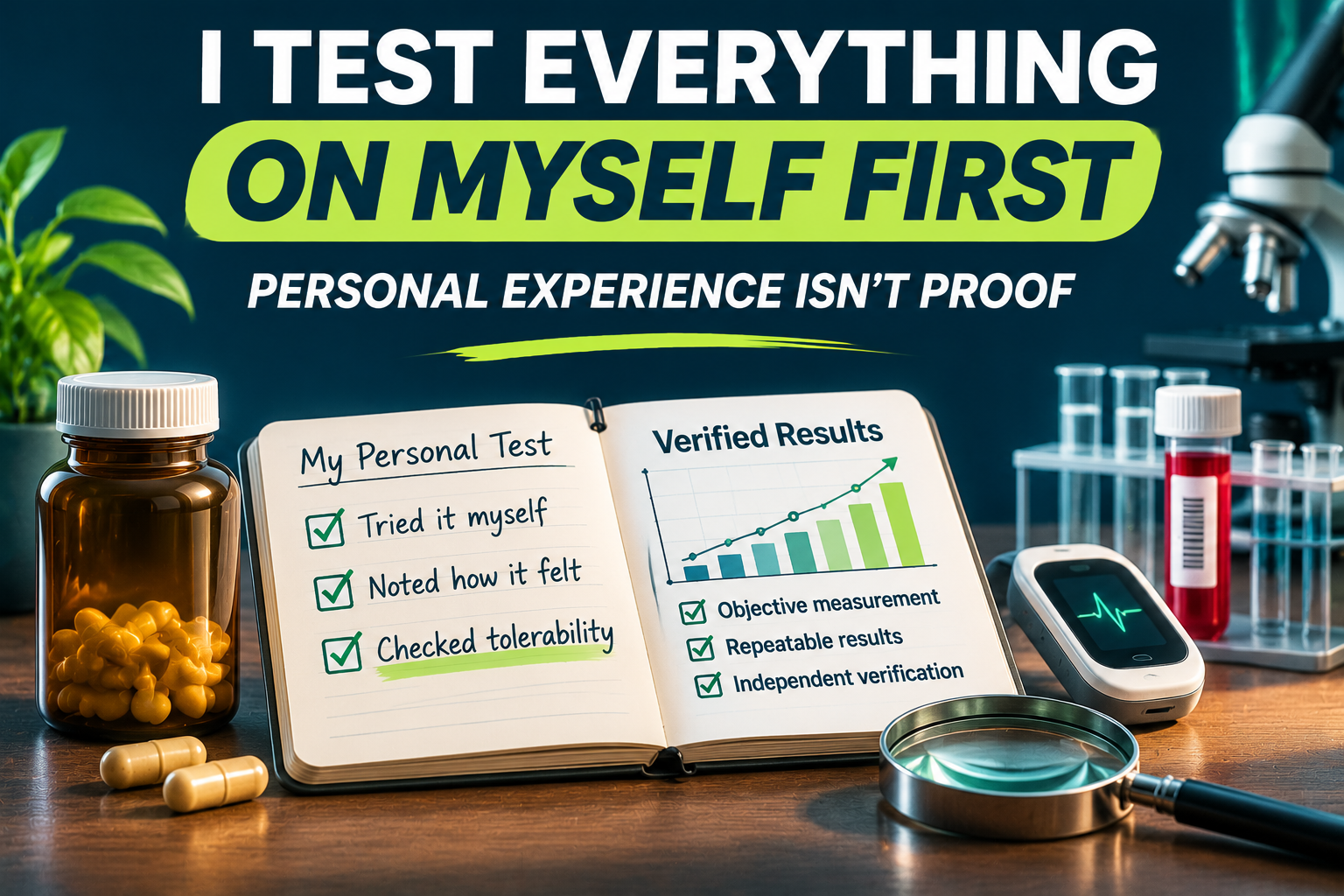
By Dr. Chris Cormier, DC
Nothing comes into my clinic that has not gone into me first. Not a supplement, not a device, not a protocol. I am the guinea pig, and I have been the guinea pig for about thirty years.
People tend to hear that and find it reassuring. For a long time I found it reassuring too.
Then I actually looked into what self-experimentation can and cannot tell you, and I had to revise what I thought I was doing. I still do it. I do it for a completely different reason than I used to, and the reason is better than the one I started with.
Why I started
It began as something closer to manners than method. I did not like the idea of handing somebody a bottle or sitting them under a piece of equipment when I had no personal idea what it felt like. If a thing made you jittery for two hours, I wanted to be able to say so, because I had been jittery for two hours.
So I became the first stop. New device, I used it. New formula, I took it. If there were side effects to find, I wanted to find them on myself rather than hear about them from somebody who had trusted me.
That instinct is still right. What I got wrong was what I thought it proved.
The part I had backwards
There is a formal version of what I imagined I was doing, and it has a name. A properly designed single-patient study is randomised, usually blinded, and runs across multiple crossover periods — the treatment given, withdrawn, given again, in an order the participant does not choose. Where it is possible, neither the person taking it nor the person assessing it knows which period is which. Outcomes get recorded on a standardised instrument, a validated diary or rating scale, rather than as an impression.
One methodological review of randomised single-patient trials found around three quarters of them incorporated blinding, and more than forty per cent built in a washout period between phases.
Now set that beside what I actually do. I choose the product. I know exactly what it is. I know what it is supposed to do. There is no control period, no randomisation, no washout, nobody blinded to anything, and my outcome measure is how I reckon I feel.
What I have been calling self-experimentation for thirty years is not a single-patient trial. It is a man taking something he picked out and then having an opinion about it.
That was an uncomfortable sentence to arrive at. It is also plainly true, and I would rather say it than keep implying otherwise.
The four ways I could fool myself
This is not a modern discovery. A physician in Bath worked it out in the seventeen-nineties, running a fairly elegant comparison between a metal device said to cure rheumatism and an identical-looking wooden copy that could not possibly have done anything. The wooden ones worked about as well.
What he demonstrated is that informal trials of therapy — simply comparing how somebody was before and after — generate false positives through four routes, and all four of them are still here.
- The placebo response, which is real and substantial and does not care that you are a clinician.
- The desire to please, which operates in both directions between the person giving and the person receiving.
- Pre-existing expectation — what both parties already believed was going to happen.
- Natural history, which is the big one. Most things that are going to get better get better anyway, and whatever you happened to take on the Tuesday gets the credit.
Here is the part that should have occurred to me sooner. I do not have an average exposure to those four. I have the worst possible exposure to all of them at once. I selected the product. I am often the one who had it made. I have usually spent money on it, sometimes a great deal, and I would very much like it to work.
If you set out to design the single least reliable observer for a given product, you would design me.
So why do I still do it
Because somewhere in the middle of working all that out, I realised I had the category wrong.
Taking it myself first was never evidence. It is a standard. The claim it supports is not “this works” — I cannot get there from one unblinded person with a strong preference. The claim it supports is narrower and, I think, more useful: I will not put something in front of you that I have not been willing to put in myself.
That is an ethical position rather than a scientific one, and the two get conflated constantly in my industry. Somebody takes their own product, feels good, and reports that as though it settled something. It did not settle anything. It just meant they were prepared to go first.
Going first is still worth something. It is simply worth something different from what it is usually sold as.
What it is genuinely good for
I do not want to overcorrect, because there is one job that self-experimentation does perfectly well, and it is worth separating out from the one it cannot do.
It is poor at efficacy. Did this make me healthier, did it work, did it help — those are exactly the questions the four biases ruin, because they are slow, invisible and open to interpretation.
It is reasonable at tolerability. Does this taste so unpleasant that nobody will finish the bottle. Does it keep me awake. Does it upset my stomach at the dose on the label. Does this device get uncomfortably warm after twenty minutes. Those effects are immediate, unmistakable and hard to talk yourself into, which is precisely why self-experimentation survives on that side of the line and collapses on the other.
So when I go first, the useful report I can give you afterwards is not that something worked. It is that I took it for a month and here is everything unpleasant that happened, which was this, or nothing. That is a smaller claim and I can actually stand behind it.
The time it genuinely mattered
Years ago I developed a whole-food liquid formula. A manufacturer I did not know but who came recommended produced the first samples and sent them over.
I opened the box and it smelled wrong. That is the whole observation. It smelled wrong.
So I sent it away to an independent laboratory and had it analysed. It came back containing ingredients that had no business being in it. Nothing was ever distributed. The formula went elsewhere and the first iteration was scrapped.
For a while I told that story as a win for having a good nose, which is a flattering way to tell it and is not quite what happened. It is also, incidentally, the one moment in thirty years of self-experimentation where going first unambiguously prevented something. My nose did not establish anything. My nose produced a hunch. What established something was posting it to people with instruments who had no stake in the answer.
That is the lesson I actually took from thirty years of self-experimentation, and it took me far too long to get to it:
My instinct is reasonably good at telling me when to check something. It is no good at all at telling me what is true.
Those are different skills. I spent a long time treating them as one.
What I would tell you to do instead
People ask me how to tell whether something is working for them, and the honest answer is that careful self-experimentation gets you closer than most people bother to go, without needing a laboratory.
- Change one thing. The usual reason somebody cannot say whether a supplement helped is that they started it in the same fortnight they started sleeping better and walking more.
- Write down beforehand what you expect to change, and how you will know. Deciding afterwards is how everything becomes a success.
- Measure something rather than consulting your impression. Hours slept, resting heart rate, how far before you notice, a score out of ten written in the same notebook at the same time of day.
- Record a baseline first, and give it four to six weeks.
- Where you can, get a number that is not your own opinion. Bloodwork is the obvious one.
My colleagues at Body Charger put the practical version of this together in biohacking at home, and EBOO Prime wrote about measuring whether a treatment is doing anything in how do you know if a treatment is working.
One addition, and it comes from the clinic rather than from me: when you are totting up what you take, total it properly. People leave supplements off the list because they do not feel like medication, and the amounts add up in ways nobody intends. The Nerve Health Institute wrote that up in vitamin B6 toxicity and nerve symptoms.
What it changed about how I practise
Three things, and they have all outlasted any individual product I ever tested.
The first is that I became much slower to say a thing works, and much quicker to say I like it and here is why, which is a different sentence and an honest one.
The second is that I stopped treating my own enthusiasm as information. Enthusiasm is a feeling I have about a purchase. It belongs in the same category as the purchase, and no amount of self-experimentation will convert it into anything sturdier.
The third is that I got far more interested in the paperwork — the independent testing, the published figures, the question of who measured something and under what conditions. It is the least romantic part of this work and it is the part that has saved me from the most mistakes. I wrote about what else I have learned to be sceptical of, including about myself, in I’ve stopped being impressed by good genes.
I am still the guinea pig. Everything still goes through me first. I have simply stopped pretending that makes it true — and if you want to apply the same scrutiny to a clinic, including mine, EBOO Prime published the checklist for that in how to check out a clinic.
It turns out that being willing to go first and being right are two entirely separate virtues. I would like to have both. I will settle for being honest about which one I have demonstrated on any given day.
Questions people ask me about this
Does self-experimentation actually prove anything?
Informal self-experimentation — trying something and noticing how you feel — does not reliably establish that a treatment worked for efficacy purposes, because placebo response, expectation, the wish to please and ordinary natural recovery all produce the same impression. Formal single-patient trials are a different matter: randomised, usually blinded, with standardised outcome measures. Almost nobody doing it at home is doing that.
Should a practitioner try their own products?
I think so, but for the right reason. It is not evidence and should never be presented as evidence. It is a willingness to go first, which is a reasonable thing to expect of somebody recommending anything to you.
How can I tell if something is working for me?
Change one thing at a time, write down in advance what you expect and how you will measure it, record a baseline, give it four to six weeks, and wherever possible use a number rather than an impression.
More essays
I write about what practice teaches you, as opposed to what you expected it to. The rest is at drchriscormier.com/writing, there is more about me at about, and you can reach me through contact.
Spark your cells to optimal longevity.
— Dr. Chris Cormier, DC