By Dr. Chris Cormier, DC
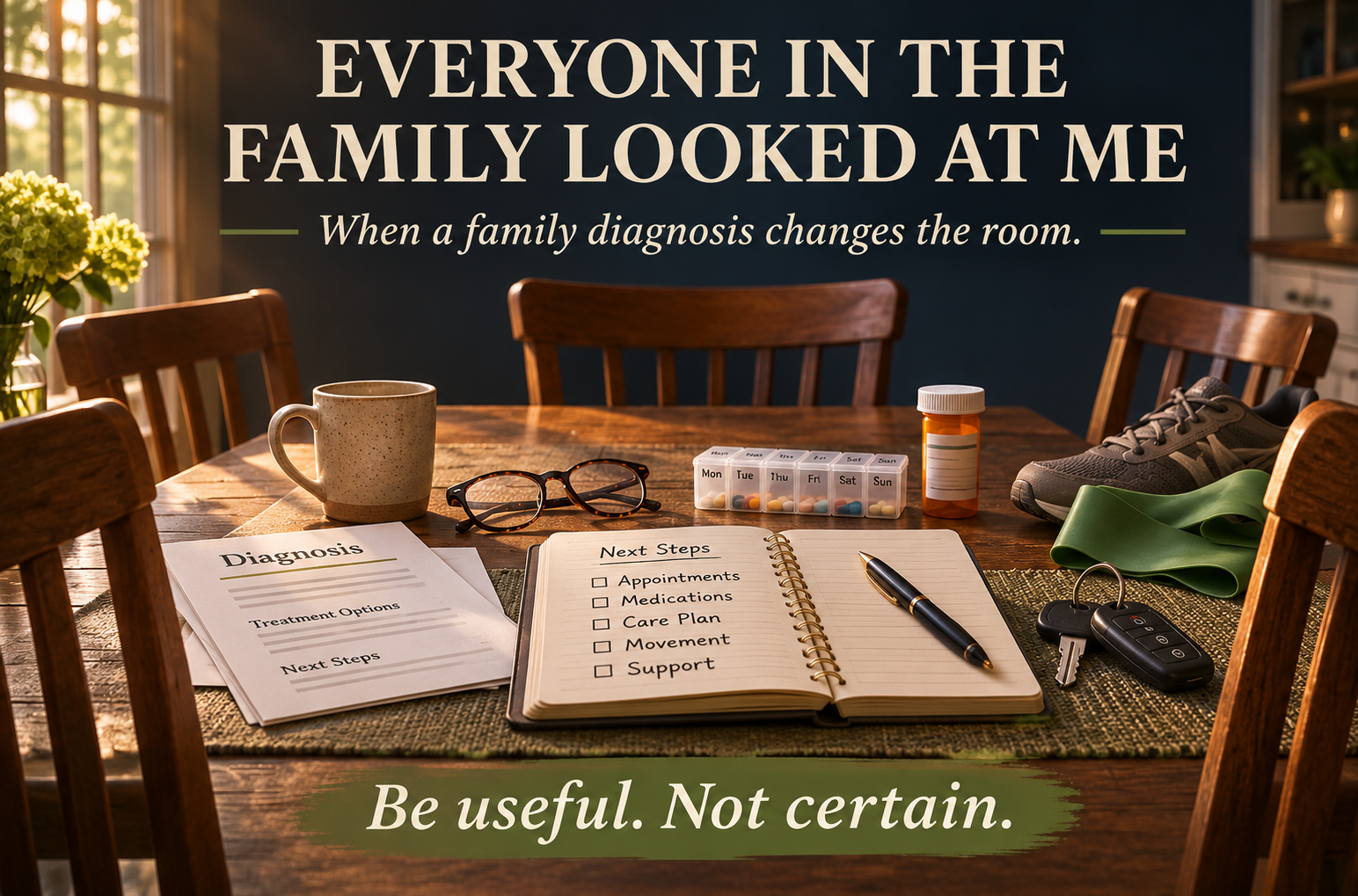
If you recorded me for a week and counted the words, I suspect the winner would be “why”.
Somebody tells me their knee hurts and I want to know why. They tell me the knee started hurting after they changed jobs and I want to know why that would matter. I have been known to say “root, root, root” out loud, like a man trying to dig through a floor. It is the most useful habit I have and my family find it exhausting.
This essay is about the one thing that habit does badly. It took me an uncomfortably long time to see it, and I only saw it because I heard myself doing it out loud.
Why the instinct is usually right
Most of what walks into a clinic is a symptom standing in for something else. The knee that is actually a hip. The fatigue that is actually sleep. The headache that is actually a jaw, or a prescription, or a Tuesday that has been going on for four years.
If you treat what presents, you will be busy forever and helpful sometimes. Looking for the root cause is what separates a practitioner from a dispenser, and I would defend that instinct against almost any objection. It is the reason people drive a long way to see me.
It is also, like most strengths, a thing that does not know when to stop.
The case that showed me the edge
Some conditions do not have a story behind them. They have a mechanism, and the mechanism is the whole answer.
A child born with an inherited bleeding disorder has it because of a change in a single gene. That is not the surface of the explanation with something more interesting underneath. That is the explanation. The clinic wrote about one such condition properly in hemophilia and joint health.
And I notice what my mind does when it arrives there. It does not stop. It says: yes, but why did it appear in this family. Why this generation. What happened upstream. There must be something.
There is a word for what I am doing in that moment, and the word is not “investigating”.
What the instinct does when there is nothing there
It builds something. Quietly, and in good faith, and out of whatever material is lying around.
Give a root cause habit a question with no available answer and it will not return empty-handed. It will produce a story — an ancestor, an exposure, an old injury, a grief nobody talked about. The story will be coherent. It will feel like insight. It will have the particular satisfying click of a thing falling into place.
And none of that is evidence. It is the shape of an explanation, arriving in the absence of one.
I have caught myself doing this more than once, and I want to be specific about why it bothers me rather than leaving it as modesty.
The sentence I stopped halfway through
A mother brought her son in. He had an inherited condition, diagnosed young, nothing ambiguous about it. She was not there about the diagnosis — she wanted help with something practical, the way most people do.
And at some point she asked me the question parents always ask, in the particular voice they ask it in. Why him. Why our family.
I started answering. I was three or four words into something about what can happen in previous generations — the kind of thing I had said before without thinking twice — and I watched her face while I said it.
She was not looking for information. She was looking for the point where it became her fault, and I was walking her toward it with the confident tone of a man who knows things.
I stopped mid-sentence. I said I did not know why, that nobody knew why, that it was not something she or anybody before her had done, and that the useful question was what we did from here. Her shoulders came down about an inch. We had a much better conversation after that, and it was a conversation about her son rather than about her.
I think about that inch quite often.
Two reasons it is not harmless
The first is that these stories land on people.
If I tell a family that something upstream of them set this in motion, I have handed them a job nobody can complete and a weight nobody asked for. Parents of a child with a genetic condition are already running a private inquiry into whether they caused it. They do not need a professional joining in. I wrote about the weight people carry from family medical history in my mother had it too.
The second reason is the one that actually keeps me honest.
A satisfying explanation is a competitor to a working treatment. If somebody believes the real problem is being addressed somewhere deeper, the ordinary, proven, slightly boring thing that was going to help them becomes optional in their mind. Nobody announces that decision. It just quietly becomes less urgent.
In most of what I see, the stakes of that are small. In a few conditions they are not small at all, and a bleeding disorder is one of them. That is a line I will not go near, and I would rather say so in my own words on my own site than leave anybody guessing.
The question I ask myself now
Am I finding this, or am I building it?
It is a short question and it is surprisingly hard to answer honestly in the moment, because building feels exactly like finding from the inside. That is the whole problem with it.
The tell I have learned to watch for is elegance. When an explanation is unusually neat — when it ties three unrelated things together and resolves the whole history in one move — that is the moment to slow down rather than speed up. Reality is rarely that tidy. My own enthusiasm is the least reliable instrument I own, which is a lesson I have now learned in at least three different outfits: I test everything on myself first and I’m the patient I warn people about are two of them.
Two piles
What I do now is sort things into two piles before I start digging, which sounds obvious and took me twenty years.
In the first pile are the things with a modifiable cause sitting behind them. Most of what I see. Here, asking why repeatedly is exactly right, and I will ask it as many times as it takes.
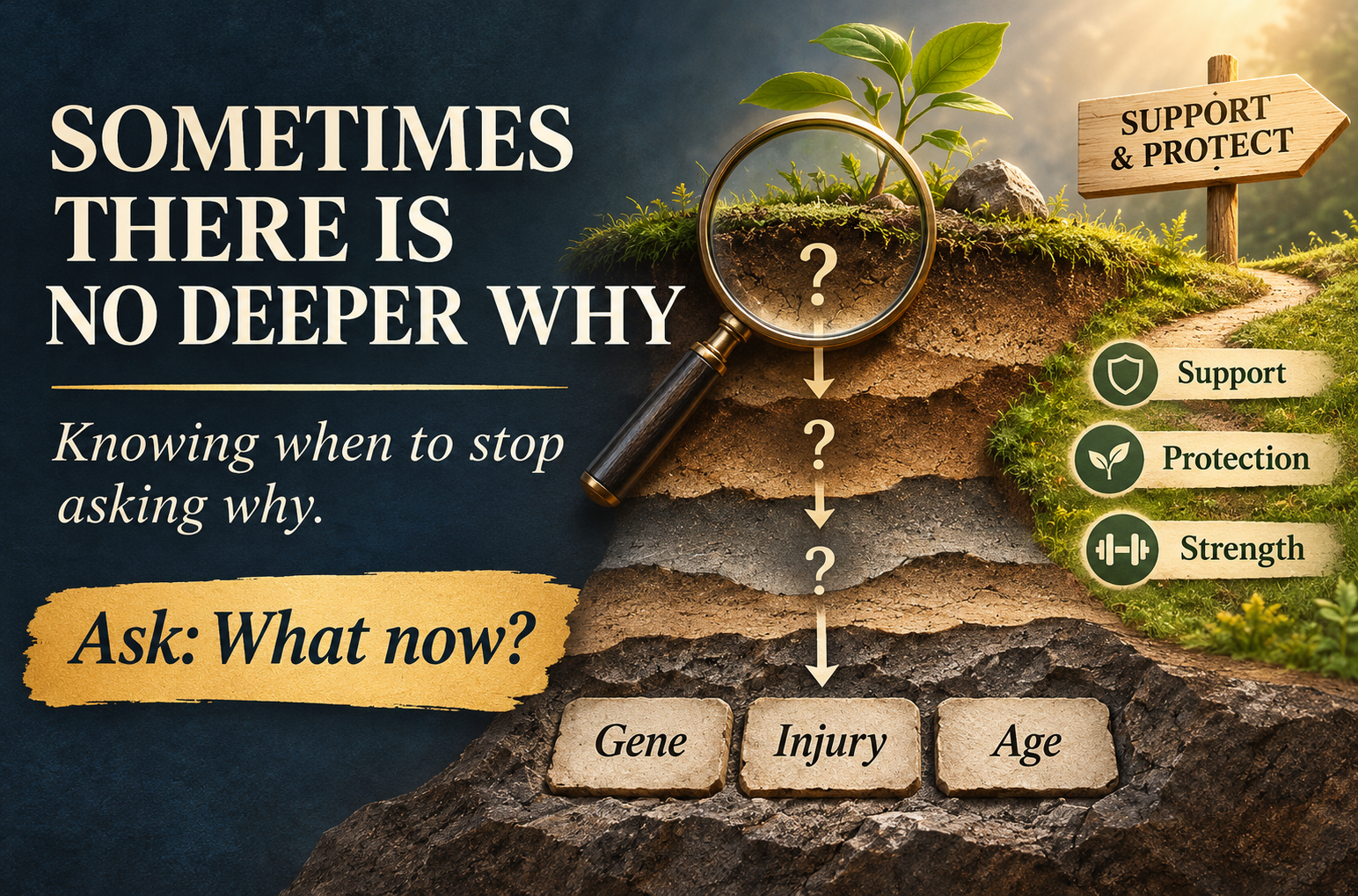
In the second pile are the things where the cause is simply the cause. A gene. An injury that happened. An age. Here the question is not why, because why has already been answered. The question is what now — what can be protected, supported, strengthened, made easier.
And the second pile is not the small or disappointing one, which is the part people assume. There is an enormous amount of work in it.
Joints to protect before they are damaged rather than after. Sleep to get back, which almost everybody with a long-term condition has quietly lost. Strength to build around a vulnerable area. Confidence to rebuild in somebody who has started moving carefully and is now moving badly as a result. A family to educate so the load is shared. A life to arrange around something that is not going anywhere, so that it takes up less room than it currently does.
I would argue that is the more skilled work of the two, because nobody gets the satisfaction of a revelation at the end of it. There is no moment where you lean back and say: there it is. There is just somebody sleeping better in March than they did in January, and nobody applauds that.
What is still true
I am not writing myself out of root cause thinking. It remains most of what I do and I would be a worse practitioner without it.
For the great majority of people who come to see me, there genuinely is something behind the thing, and nobody has looked. I would still rather be the person who asks three times too often than the one who asks once too few, and I will keep saying “root, root, root” until somebody stops me.
What has changed is that I have added two sentences to the vocabulary. One is “I do not know.” The other is “this one just is.”
They are unglamorous sentences and they have made me better at this than any technique I have learned. A practitioner who cannot say them will eventually fill the gap with something invented, and they will do it sincerely, and the person in front of them will believe it.
Some things have a deeper why. Some things only have a what now. Knowing which is which is, I think, most of the job.
Questions people ask me about this
Is there always a root cause?
No, or at least not always one you can act on. Plenty of conditions have a cause that is simply the cause — a genetic change, an injury, the passage of time. Searching behind those tends to produce a story rather than a finding, and the story can be convincing enough to be a problem.
How do you tell real root cause work from a good story?
Ask whether you are finding it or building it. In practice, be most suspicious when an explanation is unusually elegant and resolves everything at once. Reality is rarely that tidy, and the satisfaction of a neat answer is not the same as evidence for it.
Does this mean holistic approaches do not work?
Not at all, and I have spent my career in them. It means being clear about which category something falls into. Where there is a modifiable cause, go after it properly. Where there is not, the honest offer is support, protection and quality of life — alongside whatever specialist treatment exists, never in place of it.
More essays
I write about what practice teaches you, as opposed to what you expected it to. The rest is at drchriscormier.com/writing, there is more about me at about, and you can reach me through contact.
If you are weighing up whether something of your own is worth mentioning to somebody, Body Charger wrote a practical guide to that in when to see a doctor.
Spark your cells to optimal longevity.
— Dr. Chris Cormier, DC