By Dr. Chris Cormier, DC
Two people come to mind whenever anyone asks me about genetics and longevity, and I think of them in the same breath because together they make no sense at all.
One was in his mid-thirties. Built well, nothing in the family history worth writing down, the kind of raw material a physiologist would call excellent. He had been handed, by any reasonable measure, a very good body.
The other was in her seventies, and had started out with almost none of those advantages. A family history that would make an actuary wince. Decades of illness behind her. A medical file you needed two hands to lift.
She was doing better than he was. Not marginally. Obviously, visibly better, in the ways that actually show up in a room — how she moved, how she recovered, how she looked at four o’clock on a long day.
I have now seen some version of that pair several hundred times. It took me an embarrassingly long while to stop being surprised by it.
What I used to believe about genetics and longevity
Early on, I was quietly impressed by good genes. I would never have said so out loud, because it is not the sort of thing you say to the person who did not get them. But somebody would sit down with excellent raw material and I would make a private prediction about how their sixties were going to go.
I was wrong often enough that I eventually had to stop making the prediction. And then I had to go and find out why I kept being wrong, which is where genetics and longevity stop being a tidy subject and start being an interesting one.
The number everyone quotes
Ask how much of longevity is genetic and you will usually be told somewhere between twenty and twenty-five per cent. That figure comes from twin studies, and it has been remarkably durable — individual estimates have ranged roughly from fifteen to thirty-three per cent across Danish twins, Swedish twins, European nobility, Amish communities and Utah genealogies.
Then it got lower. Large pedigree analyses — one of them using hundreds of millions of people from public family trees — put the heritability of human longevity well below ten per cent, with other pedigree work landing somewhere between six and sixteen. The explanation offered was assortative mating: people tend to partner with people like themselves, which makes families look more genetically alike in their lifespans than they really are.
For a while that was the fashionable conclusion on genetics and longevity, and it was a very convenient conclusion for somebody in my line of work. Genes barely matter, so come and see me.
Except that is not where the research has settled. A 2025 paper argued that those estimates are themselves confounded, because the historical populations they come from had high rates of death from accidents and infections — deaths that have nothing to do with biological ageing. Separate out that kind of mortality, the authors argue, and the heritability of intrinsic human lifespan comes back up to around fifty per cent.
So the honest position on genetics and longevity, today, is that the field is actively arguing about it. Anybody telling you the number is settled is telling you something they do not know.
I would rather tell you that than tell you the version that suits me.
The sentence that changed how I read all of it
Here is the part that took me longest to absorb, and it has nothing to do with which estimate for genetics and longevity turns out to be right.
Heritability is a population statistic. It is not a prediction for an individual person.
Twenty-five per cent heritability does not mean that a quarter of your life is fixed by your DNA and the remaining three quarters is yours to play with. That is not what the number says. It describes how much of the variation across a whole population can be attributed to genetic differences, in that population, in that era, under that particular model. Change the population or the era or the causes of death and the estimate moves.
Which means that when somebody asks me how much of their own longevity is genetic, they have asked a question about populations and they are going to get back an answer about populations — and then they will try to apply it to themselves, which is the one thing it was never able to do.
I find that freeing rather than frustrating. The statistic was never about you. It was never going to tell you how your sixties will go. Which leaves the question of what actually does — and that is where the whole subject becomes a practical one rather than an academic one.
A beat-up car and a Ferrari
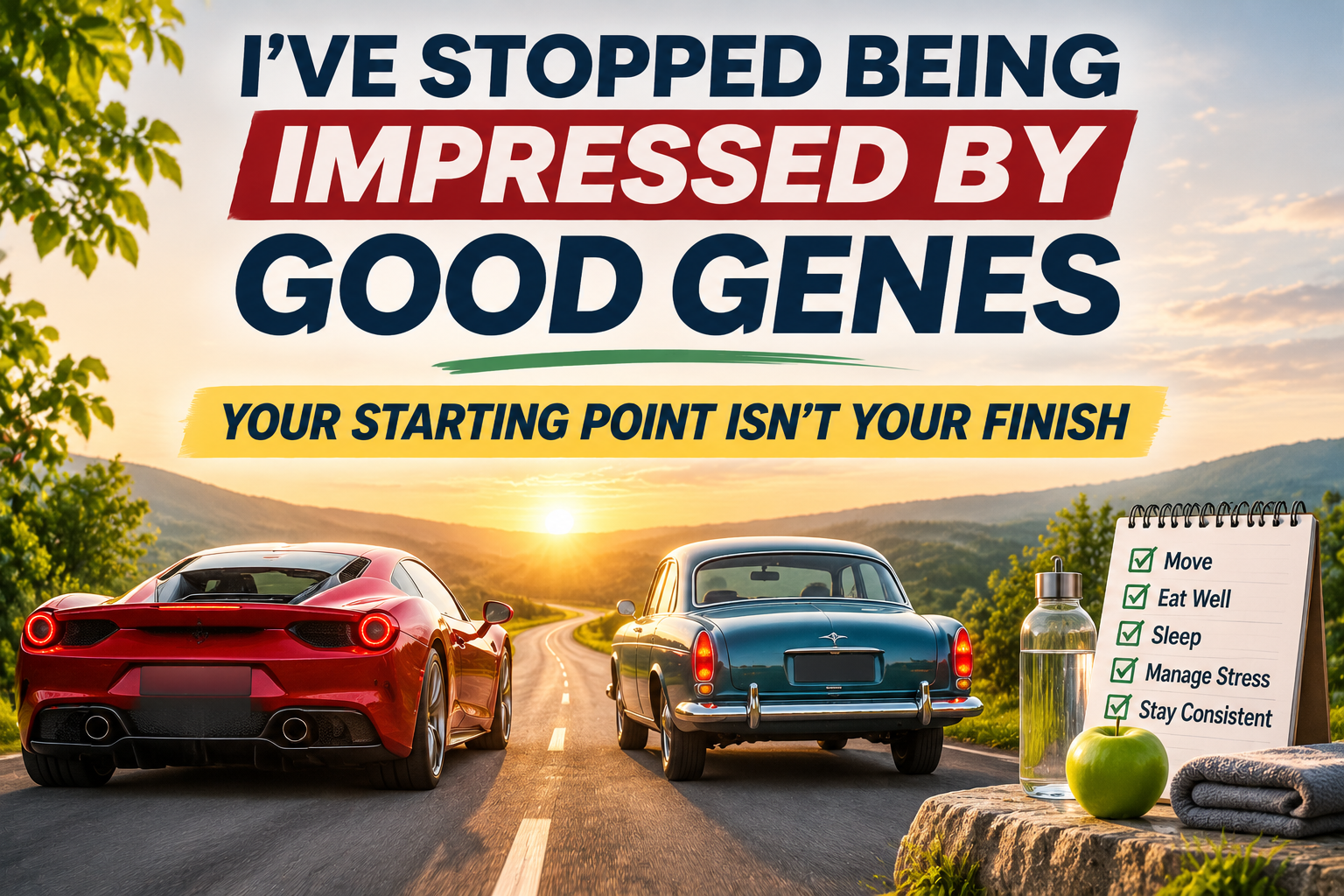
The way I have always explained this to patients is with cars, and I will keep using it because it is the only version anybody remembers.
Some people are handed a beautiful car. Some people are handed one that has already been round the block a few times before they ever got the keys. Nobody gets to choose, and nobody starts with a perfect set.
What I did not understand for years is how little the starting car tells you about where that car is at sixty.
I have watched people with beautiful cars put almost nothing into them and arrive at thirty-five with the thing already struggling. I have watched people with the beat-up car look after it with real attention for twenty years and end up driving something far better than they were handed.
That is not a motivational line. It is just the thing I see, over and over, and it is the reason I stopped making private predictions about anybody’s sixties.
What I watch for now instead
When somebody new sits down in front of me, I am no longer interested in what they started with. Genuinely not interested. I am watching three things.
- Direction, not position. Not where somebody is, but which way they are heading, and how fast. The slow version of that is the hardest to spot in yourself, which is why I wrote the morning you stopped noticing.
- The ordinary Tuesday. Not what somebody does when they are motivated — what they do on an unremarkable day when nobody is watching and nothing is at stake. That is the behaviour that accumulates.
- Whether anything is quietly unfinished. Not acute problems, which announce themselves, but the things that started and never properly closed out. My colleagues at EBOO Prime cover that in chronic inflammation.
None of those three has anything to do with what anybody was issued at birth, which is why they interest me far more than anybody’s starting position does. All three are available to be changed this afternoon.
The part I don’t get a vote on
Here is something I have become comfortable saying out loud, which took me a long time.
I cannot tell you how long you are going to live. Not from your family history, not from your bloodwork, not from thirty years of watching people. When your number comes up is not mine to decide, and I stopped pretending otherwise a long while ago.
What I can affect is the middle. How you feel on an ordinary Tuesday during the years you do get. That is the entire job. It is a smaller job than most people expect when they first walk in, and it turns out to be the only part that was ever available to anyone.
I have written about the moment that distinction landed for me, in I thought my job was to give people more. The colleagues at The Nerve Health Institute make the same case from the clinical side in healthspan vs lifespan.
If you think you started badly
Then this is the best news on the page, and I want to be precise about why.
Not because genetics and longevity are unrelated — I have just spent several paragraphs telling you the research is still arguing about exactly how closely. But because nothing in any of that work says your starting position determines your finish. A population statistic cannot do that. It was never built to.
What I can tell you from the room, rather than from the literature, is that the people who impress me most at seventy are very rarely the people who were handed the most at twenty. Some of them are people who were handed almost nothing and decided, somewhere along the way, to look after it anyway.
If what you are carrying is a family story rather than a diagnosis, I wrote about that particular weight in my mother had it too.
And if you think you started well
Then this is the part worth hearing, and I will say it kindly because it is not a telling-off.
The people I think about most are the ones who have never had to consider their health, because nothing has ever made them. Good raw material buys you time before the question gets asked. It does not exempt you from the question.
The thirty-six-year-old in the first paragraph of this essay was not careless and he was not foolish. He simply had never been given a reason to pay attention, and so he had not. That is not a character flaw. It is just what happens when the feedback arrives late.
I have written about what it is like to watch that arrive on schedule in I’m the age of my patients now.
What I am impressed by now
Not good genes. I have seen too many of them go to waste, and too many poor hands played beautifully, to carry that particular reverence around any more. Genetics and longevity are related, certainly. They are not the same subject.
What impresses me is what people do on an ordinary day, repeatedly, for years, whether or not anybody is watching. It is unglamorous and almost entirely invisible while it is happening. And it is the thing that eventually shows up in the room, in how somebody moves and recovers and holds themselves at the end of a long afternoon.
A hundred years is thirty-six thousand five hundred and twenty-five days. Most of them are unremarkable. They are also the ones doing the work.
If you want the practical version of all this rather than the reflective one, the people at Body Charger built how to know what health advice to trust, which is where I would start if I were sorting through the noise for the first time.
Questions people ask me about this
How much of longevity is genetic?
It depends who you ask and when you asked them. Twin studies have long put it at roughly twenty to twenty-five per cent; large pedigree analyses have put it below ten; a 2025 paper arguing that those figures are confounded by deaths unrelated to ageing brings it back up towards fifty for intrinsic lifespan. The field is genuinely unsettled, and anyone quoting you a single confident number is overstating what is known.
Does family history determine how long I will live?
No. Heritability describes variation across a population, not a forecast for a person. Family history is useful information for you and your doctor — it tells you where to look and what to screen for. It is not a verdict.
Can how I live actually change my genetic starting point?
It does not change the genes you were issued. What it changes is almost everything downstream of them — which is, in practice, most of what you experience as your health. In thirty years I have watched people improve dramatically from unpromising starting positions, and I have watched excellent starting positions go unused.
So what should I actually do about genetics and longevity?
Stop treating your starting position as the headline. Pay attention to direction rather than position, to ordinary days rather than motivated ones, and to anything that has started in your body and never properly finished. Those are the three things I watch, and none of them care what you inherited.
More essays
I write about what practice actually teaches you, as opposed to what the textbooks said it would. The rest is at drchriscormier.com/writing, there is more about me at about, and you can reach me through contact.
Spark your cells to optimal longevity.
— Dr. Chris Cormier, DC