By Dr. Chris Cormier, DC
For most of my working life I understood what I did as addition.
People arrived depleted. They were short of something — sleep, oxygen, movement, calm, attention — and my job was to work out which, and supply it. Find the deficit, fill the deficit. It is a clean way to think about health, it is genuinely useful, and I would guess most people in this field start there.
I no longer think it is wrong. I think it is about half of the picture, and I was slow to notice the other half.
The thing that changed it
What changed it was a protocol built on doing the opposite.
The idea is simple enough. Rather than supplying something steadily, you alternate: a period of abundance, then a brief period where the supply is deliberately reduced, then abundance again. Repeat. The body is not given more of what it needs. It is briefly asked to manage with less, and then given plenty.
And it works better than simply giving more. Not marginally — noticeably. Over a course of sessions you can watch somebody become measurably more efficient at the very thing they were briefly denied.
The body does not get better at what it is given. It gets better at what it is briefly asked to do without.
I have written before about my suspicion of impressive equipment, in everyone asks about the chamber. This is not that. This is a genuine reversal of something I believed, and it took me an embarrassingly long time.
Why I resisted it
I should be honest about the resistance, because it is the interesting part.
Taking something away from somebody who came to you unwell offends the instinct that brings most of us into this work. You want to give. The person in front of you is already managing with less than they should have, and here is a method whose active ingredient is less. Everything in me wanted to turn the dial the other way.
It took a while to see that I had the grammar wrong. The reduction is not the treatment. The reduction is the question, and the abundance that follows is the answer. The adaptation happens in the space between the two. Take either half away and nothing much occurs — constant plenty teaches the body nothing, and constant scarcity simply wears it down.
What finally convinced me was watching the numbers rather than arguing with the idea. Somebody who had struggled at the start of a course managing comfortably by the end of it, through a phase that would have flattened them a few weeks earlier. Nothing had been added. Something had been repeatedly, briefly, carefully taken away and given back, and they had quietly become more capable in the process.
I am wary of how neatly that lands, so let me be careful with it.
This is not “what doesn’t kill you”
There is a version of this idea that I want no part of, and it is everywhere.
It says hardship is good for you. That suffering builds something. That people who have had difficult lives are stronger for it. I have sat across from enough people to know how rarely that is true, and how much damage the belief does to someone who is simply tired.
What makes the protocol work is not the thin phase. It is that the thin phase is brief, watched, and reliably followed by plenty. A few minutes, with somebody reading a monitor, knowing exactly when to turn it back. The demand is real, and the recovery is guaranteed. That second condition is not a detail. It is the entire mechanism.
A demand with no recovery attached is not a stimulus. It is attrition, and the body treats it accordingly.
Which is the thing I actually see
Here is the pattern, after a long time of watching it.
The people who improve most are not the ones with the easiest lives. They are also, emphatically, not the ones with the hardest. They are the ones whose hard things end.
A demanding job that stops at six. A stretch of poor sleep that finishes. A difficult season with a visible edge to it. Those people adapt, and often they adapt upward — they come out of it more capable than they went in.
The people who struggle are rarely short of difficulty. They are short of the phase that is supposed to come afterwards. The job that follows them home. The worry with no resolution date. The caring responsibility with no relief in it. Same load, no recovery phase, and the body reads it as one unbroken demand.
You can hear the difference in how people describe things, once you know to listen for it. A person in a demanding season talks about it in the past tense even while they are in it — this has been a brutal few months. A person without a recovery phase uses the present continuous. It is just how things are now. Same load, different grammar, and the grammar tells you almost everything.
When I first understood that properly it reorganised how I listen. Someone describes a hard few months and my first question is no longer how hard. It is: and when does it stop?
What I changed
Less than you might think, and it has made more difference than most of what I have added over the years.
I ask about endings. Not just what someone is carrying, but whether it has an edge — and if it does not, whether an edge can be built into it. A recovery phase that has to be arranged deliberately still counts. It does not have to arrive on its own.
I am more careful about adding things. There was a period when I would send people away with six changes to make, which I have written about in the patients who arrive with a list. Six additions to a life with no slack in it is not help. It is another demand with no recovery attached, dressed up as care.
And I have become much less grand about what counts. People hear “recovery phase” and picture a holiday, which for most of the people I meet is not available and so is not useful advice. The useful version is far smaller than that. An hour on a Sunday that is genuinely nobody else’s. A walk at lunch that is not also a phone call. A point in the evening after which work does not reopen, held imperfectly. One thing in the week that reliably stops.
What seems to matter is not the size of the gap but that it exists and that it is predictable. A small ending that happens is worth more than a large one that keeps being postponed — which is, I notice, exactly how the protocol works too. The thin phase is short. What makes it tolerable is that everybody in the room knows it is going to end.
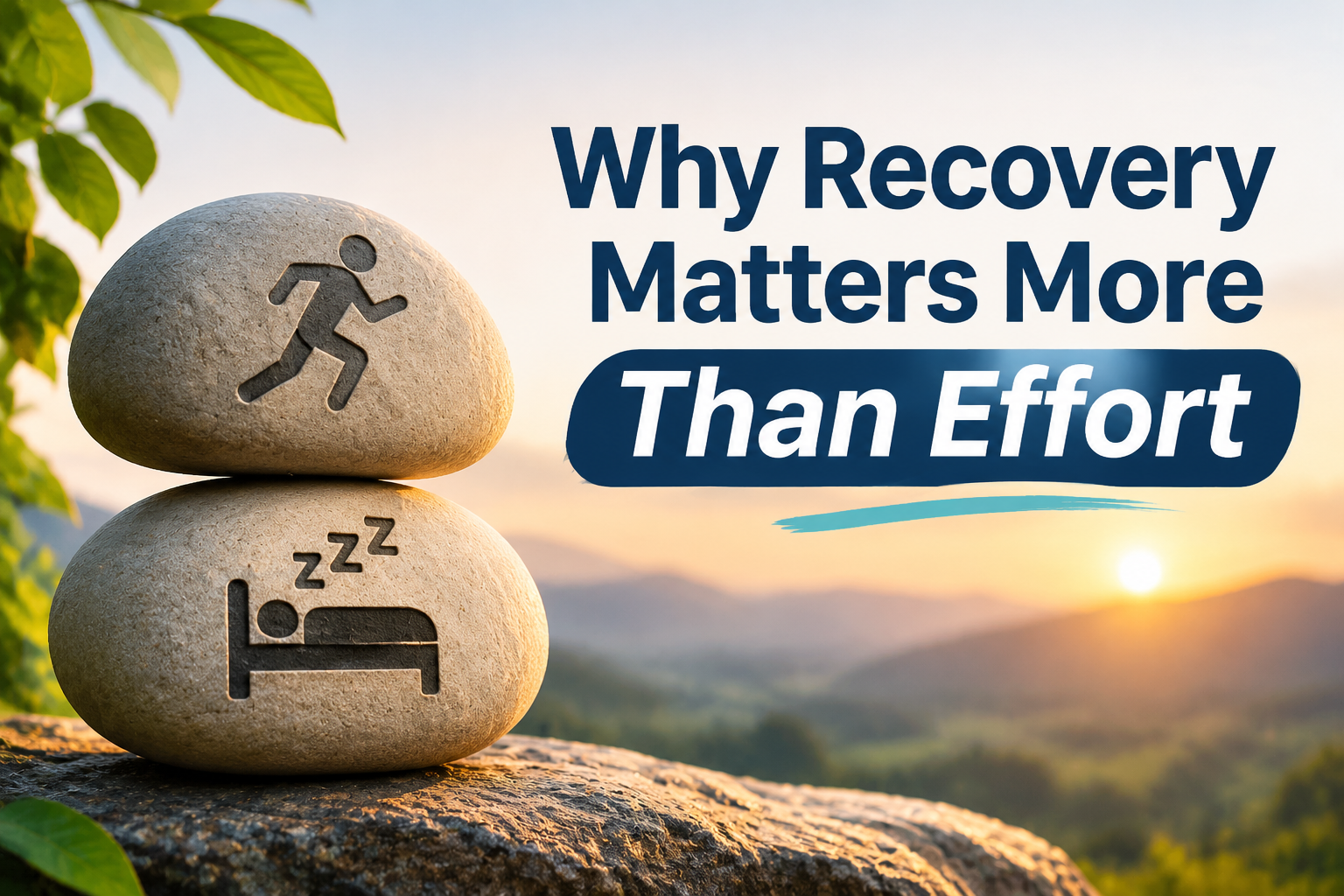
And I take rest seriously as an active ingredient rather than an absence of one. That sounds obvious written down. It was not obvious to me for a long time, and I notice it is not obvious to most of the people who sit down opposite me either. Nearly everybody treats recovery as the part where nothing is happening. It is the part where everything is happening. The demand only sets the question.
The small version
Most of this needs no equipment at all, which I find reassuring rather than disappointing.
The same shape turns up in a single breath. An in-breath and an out-breath, and almost everybody rushes the second one. Lengthen the exhale and something settles, reliably, within a few breaths — the cheapest demonstration I know that the recovery half is where the work happens. My colleagues have written a simple guide to that at BodyChargers, and the clinical version of the contrast idea is at The Nerve Health Institute if you want to see where it leads.
But the essay is not really about breathing, or about any protocol. It is about a correction I had to make to a belief I did not know I was holding.
Still adding, just not only
I have not stopped giving people more. Most people who come to see me are genuinely short of something, and finding out what is still the first useful thing I do.
What has changed is that I no longer think the supply is the whole job. Half of my work is adding what is missing. The other half is making sure something ends.
It took me a long time to get there, which is a sentence I have written before, in ten years of nearly. I seem to arrive at most things slowly. But I would rather arrive at them than keep doing the version I was confident about, and this one has changed more consultations than anything else I have learned in the last decade. A related thought on what measurement can and cannot show is in the machine I keep wishing for.
So: if you are in the middle of something hard, I am not going to tell you it is making you stronger. I am going to ask when it ends, and if the answer is that it does not, that is where we should start.
More of what I have written is at the writing page. How I came to practise this way is the about page, and you can always get in touch.
Dr. Chris Cormier, DC
Lafayette, Louisiana
Clinic care at nervehealth.com. At-home protocols at bodycharger.com. Circulation and oxygenation at ebooprime.com.
Spark your cells to optimal longevity.