By Dr. Chris Cormier, DC
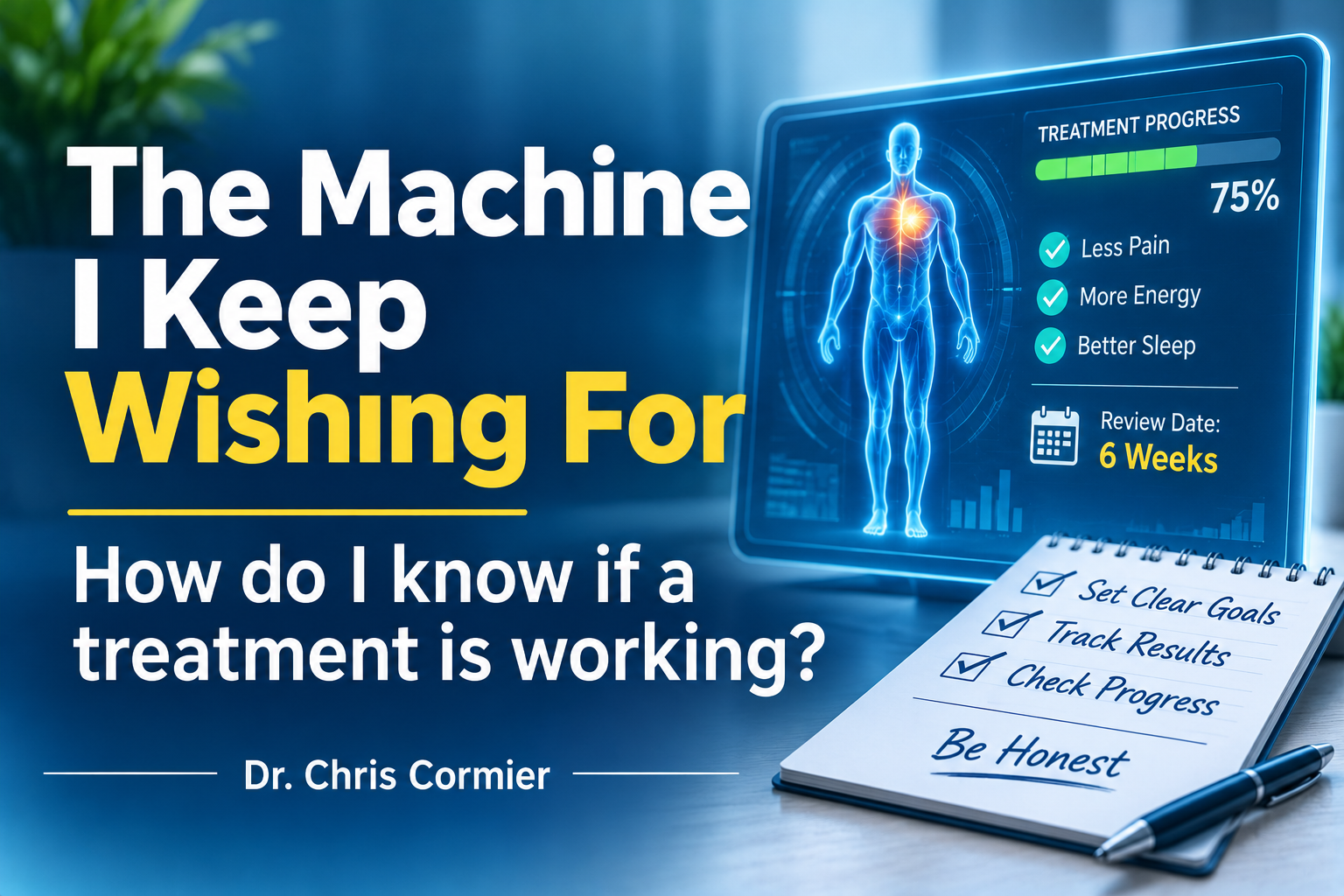
There is a device I have wanted for about twenty years, and it does not exist.
It would show oxygen at tissue level, mapped — this group of cells here, that group there, this organ running lower than that one. Not a number from a fingertip. A picture of the whole body. I have described it to engineers at conferences in the hope somebody would say it was nearly ready. Nobody has.
What we actually have
A pulse oximeter, which is a genuinely useful instrument and a narrow one.
It reads oxygen saturation in blood passing through your finger. That is a real measurement of a real thing, and it is not the same as knowing how well oxygen is reaching tissue somewhere further down the line. Nothing in routine clinical use maps that. For most of what I am interested in day to day, the instrument stops short of the question.
So I work in the gap, which is the honest description of a lot of practice in a lot of fields.
The uncomfortable second reason I want it
Here is the part I have had to sit with.
I tell myself I want the machine so I can treat people better. That is true. But I also want it because it would settle things — it would tell me, definitively, whether what I did on Tuesday made any difference. And wanting that is not purely scientific curiosity. Some of it is wanting to be relieved of the burden of judging without proof.
An instrument that could not be argued with would also be an instrument I could hide behind.
Which is worth noticing, because the gap between what can be measured and what cannot is exactly where a practitioner is most tempted. If nothing can disprove you, you can say almost anything — and the people most at risk of exploiting that are not the cynics. They are the ones who sincerely believe.
So how do I actually decide?
Without the machine, I have had to build something clumsier and, I have come to think, better.
Function, chosen in advance
Before anything starts, we pick two or three specific things that would change if this were working. Not “feeling better” — specific, boring, checkable things. How many flights of stairs before you stop. Whether you wake at three. How far into the afternoon you get before the fog arrives. Whether you can carry the shopping in one trip.
Chosen in advance, because chosen afterwards they are not evidence. They are a story.
A date
Three weeks, six weeks, whatever suits the thing. Then we look. An open-ended course of anything is not a plan, it is a subscription — and the date is what protects the patient from my enthusiasm as much as from their own.
Somebody else’s read
Where there is published evidence, I would rather know it than not, including when it is unflattering. We have just written up what the research does and does not support for oxygen and athletic performance at EBOO Prime, and the honest version turned out to be more interesting than the confident one — it supports the use during effort and does not support the sideline mask afterwards. I would not have guessed the split. That is rather the point of looking.
What I would want you to do with this
If you are starting anything — with me, with anybody, or on your own — do the same three things.
Write down two specific functional markers before you begin. Put a date in the calendar. And agree out loud what would count as it not having worked, because a treatment that cannot fail cannot succeed either. Those are the same sentence.
A practitioner who is comfortable with all three is telling you something. So is one who is not.
The part I did not expect
I assumed, for years, that the arrival of the machine would be the moment everything got easier.
I am less sure now. The useful discipline was never the measurement — it was being honest in its absence, and I only built that discipline because I had no choice. Had the device existed in 2006 I suspect I would have leaned on it, stopped watching people as closely, and lost something.
I have written elsewhere about spending years being correct and not much use, in nobody has ever argued with me about this, and about the pull toward the impressive answer in everyone asks about the chamber. This is the same lesson from a third direction: the thing that makes you good is usually the constraint you resent.
That took an embarrassingly long time to arrive, which I have written about in ten years of nearly.
I still want it, though
All of which is a long way of saying I have made my peace with the gap, not that I have stopped wanting the instrument.
If somebody builds it in the next decade I will be first in the queue, and I will still write the two markers and the date on a card before anybody starts. By then it will be habit, and habits formed under constraint tend to be the ones worth keeping.
If you want to see what we do with the measurements we do have, that is over at The Nerve Health Institute.
More of what I have written is at the writing page. How I came to practise this way is the about page, and you can always get in touch.
Dr. Chris Cormier, DC
Lafayette, Louisiana
Clinic care at nervehealth.com. At-home protocols at bodycharger.com. Circulation and oxygenation at ebooprime.com.
Spark your cells to optimal longevity.