By Dr. Chris Cormier, DC
A man had a seizure in front of me once, in a public place, in the middle of an ordinary afternoon.
Within about fifteen seconds there were four people around him. One was trying to hold his arms still. One was attempting to get something between his teeth. One was shouting his name as though volume would help. Every single one of them was doing the wrong thing, and every single one of them was being kind.
What I did, and how it felt
I moved a chair out of the way, put my jacket under his head, asked the arm-holder to let go, and looked at my watch.
That was it. That was the whole intervention. For about ninety seconds I knelt next to a stranger having a seizure and did essentially nothing, which is the correct treatment and felt like the worst thing I have ever done.
Somebody behind me said, is nobody going to help him. I understood exactly what they meant.
The instructions, and why they feel wrong
The CDC’s guidance is straightforward and almost entirely about restraint.
Stay with the person. Move things that could injure them. Put something soft and flat under the head. Roll them onto their side if they are lying down, to keep the airway clear. Loosen anything tight at the neck, take off their glasses, and time it.
Then the part people get wrong:
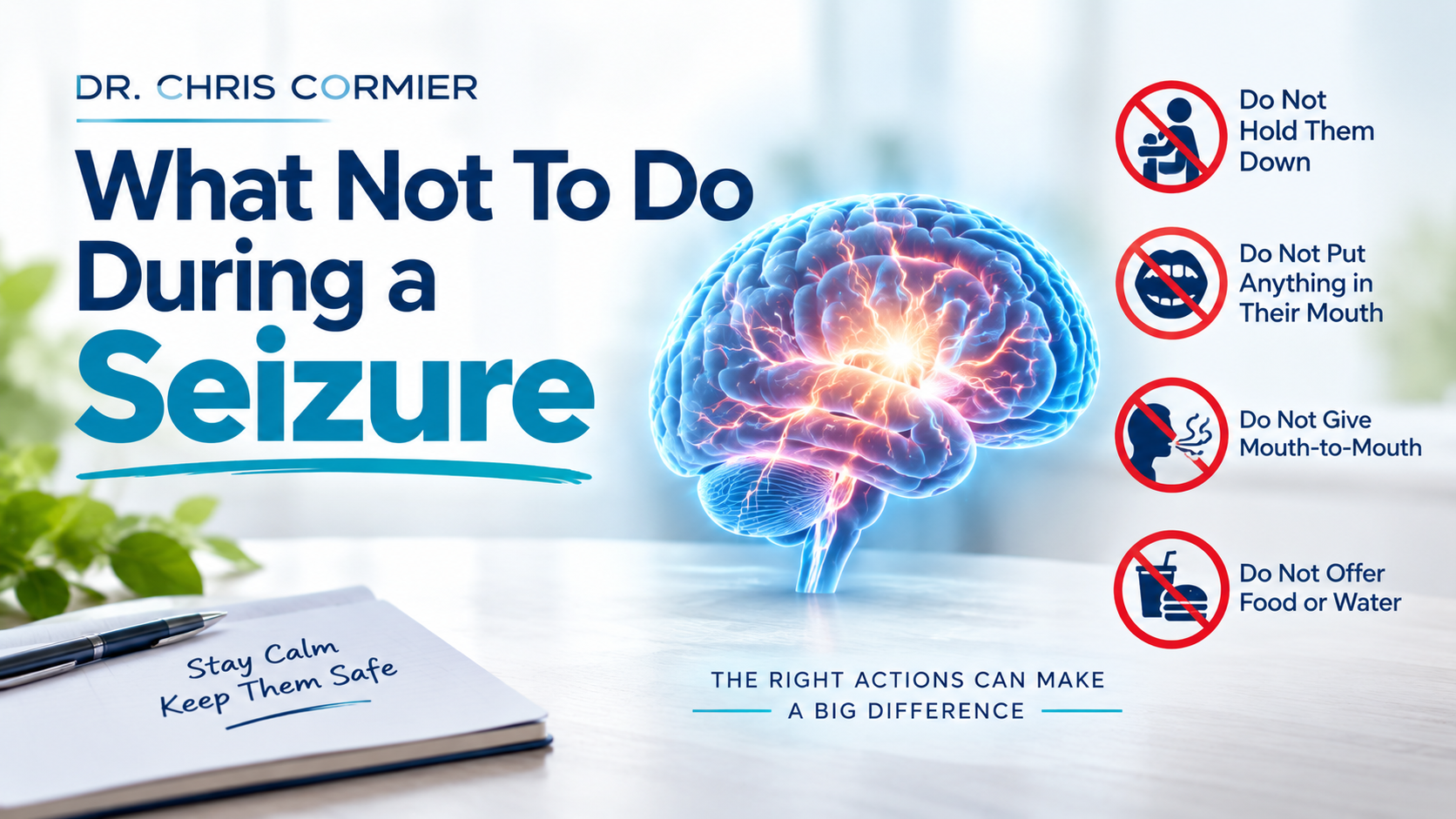
- Do not hold them down or try to stop the movements.
- Do not put anything in their mouth. Nobody swallows their tongue. What actually happens is broken teeth and bitten fingers.
- Do not give mouth-to-mouth during the seizure. Breathing usually resumes on its own.
- Do not offer food or water until they are fully alert.
Call 911 if it lasts more than five minutes, if another follows soon after, if they do not wake up or have trouble breathing, if they are injured, if it happened in water, if it is their first known seizure, if they have diabetes and lose consciousness, or if they are pregnant.
Three of those four prohibitions are things a caring person does automatically. That is what makes this hard — the instinct and the instruction point in opposite directions. The fuller write-up, with the trigger detail, is at The Nerve Health Institute.
Why watching is so much harder than acting
I have thought about that afternoon more than almost anything else in my career, and I think the explanation is simple and uncomfortable.
Acting makes the watcher feel better. That is a real benefit, and it belongs to the wrong person.
When you hold somebody’s arms during a seizure, you are not reducing the seizure. You are reducing your own distress at being unable to stop it. The intervention is for you — which is not a criticism of anybody, because it is a completely human response, and the four people around that man were better human beings than the ones who walked past.
But it does mean the test of a helpful action is never how helpful it feels.
The part that is about my own field
Here is the thought I keep arriving at, and I would rather be the one to say it.
A great deal of what happens in health and wellness is powered by exactly that instinct. Somebody is unwell, watching is unbearable, and doing something — anything — relieves the unbearableness. For the practitioner as much as the family.
That is how a person ends up on eleven supplements. It is how somebody gets talked into the most impressive thing in the building rather than the most appropriate one, which I have written about in everyone asks about the chamber. And it is how a practitioner who genuinely cares can do more than is useful and feel better for having done it.
I am not immune to this. I have written before about the pull of being the person with the answer, in I built a reputation on not doing this, and this is the same impulse wearing different clothes. Not wanting to oversell — just not being able to bear sitting still.
What doing almost nothing actually requires
It is worth saying that the restrained version is not passive, which is the thing that makes it bearable.
In those ninety seconds I was timing, watching his breathing, keeping the space clear, and getting ready for the point where he would come round confused and frightened in front of an audience. That last part turned out to be the bit that mattered most — because the hardest moment of a seizure for a lot of people is not the seizure. It is the ring of faces afterwards.
So the useful things were: ask people to step back, tell him where he was and what had happened, say it calmly and more than once, and stay until he decided what he wanted to do. He was embarrassed, which he had nothing to be embarrassed about — a subject I have written about separately in the patient who apologised for being ill.
What I would want you to take
Learn the four prohibitions. Not the whole protocol if you do not want to — just the four things not to do, because those are the ones that cause injuries and they are the ones everybody gets wrong.
And then the general version, which has served me better than most things I was actually taught: when you want to intervene, check whose discomfort you are relieving. Sometimes it is theirs, and you should act immediately. Often it is yours, and the better thing is to stay, pay attention, and be ready.
He was fine, incidentally. He sat on the kerb for ten minutes, phoned his sister, and went home. Nobody did anything heroic, and that was the correct outcome.
More of what I have written is at the writing page. How I came to practise this way is the about page, and you can always get in touch. The practical side of keeping a treatment routine intact is at BodyCharger.
Dr. Chris Cormier, DC
Lafayette, Louisiana
Clinic care at nervehealth.com. At-home protocols at bodycharger.com. Circulation and oxygenation at ebooprime.com.
Spark your cells to optimal longevity.