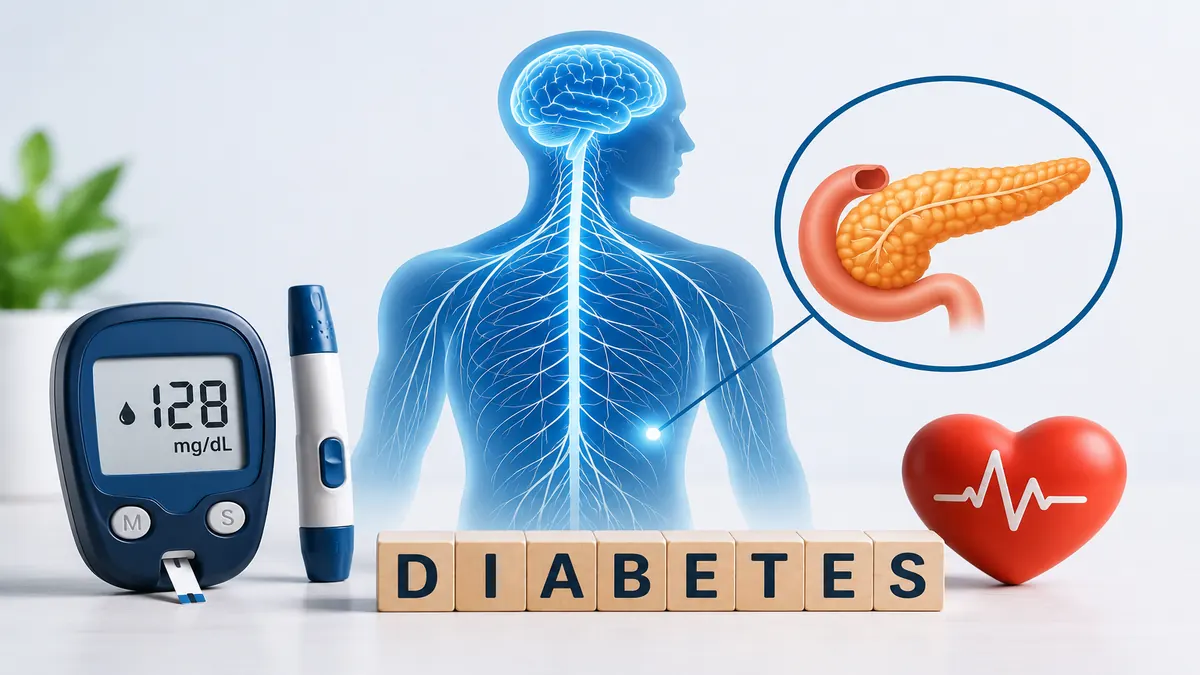
Diabetes nerve connection explained: your pancreas is wired to your brain. Dr. Chris Cormier on which nerves carry that power, and why he tests them.
I am Dr. Chris Cormier, and I have spent 27 years and more than 50,000 clinical hours working on one thing: the connection between the brain and the body’s 30 trillion cells.
When somebody sits down in front of me and says they have diabetes, the first thing I want to know is not their most recent reading. It is which nerves are carrying power to their pancreas, and how well.
That probably sounds like an odd place to start. Let me explain why I think it is the right one.
Your Pancreas Is on the Grid Like Everything Else
Here is how I see the body. Your brain is the power company. Every one of your 30 trillion cells is a house wired back to it, and your nerves are the lines carrying that power.
Your pancreas is not sitting in isolation doing its own thing. It is wired in like every other organ, and it performs according to what it is receiving.
Two pathways matter particularly here. The L3 nerve sits in the middle of your lumbar spine and is one of the primary nerves supplying the pancreas — it also serves the kidneys, adrenal glands, spleen and descending colon. And the vagus nerve, which branches from the brainstem and spreads right through the body, reaches the pancreas as well.
In my experience the L3 is one of the weakest nerves we find in people here in Louisiana. Almost nobody arriving at my clinic has ever had it properly checked, and that is a genuine opportunity rather than bad news.
What I Am Actually Measuring
I do not treat symptoms. I look at the circuit, and I want a number rather than an impression.
There are 88 primary nerves branching off the brain and spinal cord. Those are the main power lines, and because I know the route and job of every one, I can test EnergyFlow along each pathway and tell you what percentage of full power you are running at.
Think of it as having an electrician go through your power company and check every main line. For a condition that people usually track through a single blood measurement, having a second and entirely different number to work with changes the conversation.
Why Blood Sugar Is Only Part of the Story
Your blood sugar reading tells you what is circulating right now. It is genuinely useful, and you should keep tracking it.
What it does not describe is how well supplied and connected your cells are throughout the rest of your body. That is why somebody can bring their numbers into range and still feel like the lights are not fully on — and it is why I want to look at the foundations underneath the number as well as the number itself.
Your pancreas depends on clear communication with your brain, a well-functioning nervous system, good circulation, proper nutrition and a body with capacity to handle stress. Strengthen those and you are supporting the whole system rather than one measurement.
The Three Ingredients I Come Back To
Alongside reconnecting the circuit, I work with the three ingredients the body depends on most. The order is deliberate.
Oxygen. The most abundant ingredient in the human body, and the one most people could use more of. At the clinic we support it directly through hyperbaric oxygen, LiveO2 and exercise with oxygen therapy.
Water. The second most abundant. Cells function properly when they are properly hydrated, and that is where the self-healing process starts.
Light. The third. Red light and infrared work brings light energy back into the nerves and sparks cells to do their own repair.
Frequency sits alongside these. Every cell has its own tune, rather like a guitar string, and stress can pull cells out of tune. I use bioresonance and PEMF in clinic to help cells find their proper frequency again, and I recommend portable devices so patients can keep that going at home.
🎥 Watch: My Full Conversation on Diabetes
I go through all of this in detail here — the brain to pancreas connection, the nerves involved, and how I structure the work with someone who has been managing diabetes for years.
Where I Stand on Your Medication
I want to be completely clear about this, because it is important and I say the same thing to every patient.
Your insulin and diabetes medication are dosed to your body as it works today. As your body starts handling sugar more comfortably, your dosing needs may shift — and that is a good sign, and one your prescriber is the right person to manage with proper monitoring.
It is not my place to tell anybody to take a medication or not to take one. What I can do is work on the connection and the ingredients, and keep your medical team informed so they can make their decisions with good information.
What I Will and Will Not Tell You
You deserve straight answers from anyone you are considering working with, so here are mine.
I will not tell you in advance what your result will be. Every person who comes through my door has a different set of nerves with a different set of stresses acting on them, and I do not know yours until I have examined you. What I will tell you is exactly what I find, what I honestly think is achievable in your case, and whether I believe I am the right person to help.
For a lot of people the goal is quality of life — better energy, clearer thinking, more capacity through the day, alongside the treatment they are already on. In my experience that is what patients most often describe gaining, and it is a thoroughly worthwhile aim.
Why I Keep Going With This
Diabetes runs in my family. My grandmother had it and my father had it, so this is not an abstract subject for me — I know what it means to a family over the long term, and it is part of why I have spent so many years on it.
Every person who comes to my clinic teaches me something. A new set of nerves, a different combination of stresses, a pattern I have not seen in quite that form before. I will often learn something helping one patient that goes on to help a thousand others with a similar picture.
That is why we call it an Institute rather than a clinic. We are always learning, and I have never been willing to give up on somebody just because their case is complicated.
Questions People Ask Me
Why look at nerves for a blood sugar condition?
Because your pancreas is wired to your brain like every other organ, and it performs according to what it receives. The L3 and vagus nerves both reach it. If nobody has checked those, there is a piece of your picture nobody has looked at.
What should I be aiming for?
Medication decisions belong with your prescriber. What patients most often describe gaining is better energy, clearer thinking and improved quality of life alongside their existing treatment — which is genuinely valuable in its own right.
How do I know whether you are the right person for me?
Come and find out. The assessment gives us both something concrete, and if I do not think I can help you I will say so rather than start a plan.
How does this fit with my insulin?
It works alongside it. Keep your medical team informed and your monitoring going as normal, and leave any dosing decisions with your prescriber.
Do you take new patients?
Yes, though only a limited number each month, so it is worth enquiring early.
Can I start from home?
Yes. Bodychargers is my at-home programme — daily coaching with frequency-based technology, guided by coaches I have trained myself. A lot of people start there and come to the clinic later.
If This Way of Thinking Makes Sense to You
Then the next step is an assessment that looks at your circuit rather than only at your symptoms, and an honest conversation about whether I am the right fit for your situation.
Nerve Health Institute — Lafayette, Louisiana
108 Republic Ave, Ste. B · Lafayette, LA 70508
+1 (337) 456-6555
Spark your cells to optimal longevity.
— Dr. Chris Cormier, DC