By Dr. Chris Cormier, DC
For decades, nothing in my clinic broke the skin. Not once.
That was not a limitation I worked around. It was the design, and I was proud of it. People came to me specifically because of it — because there was a whole category of thing I simply did not do, and that told them something about how I thought.
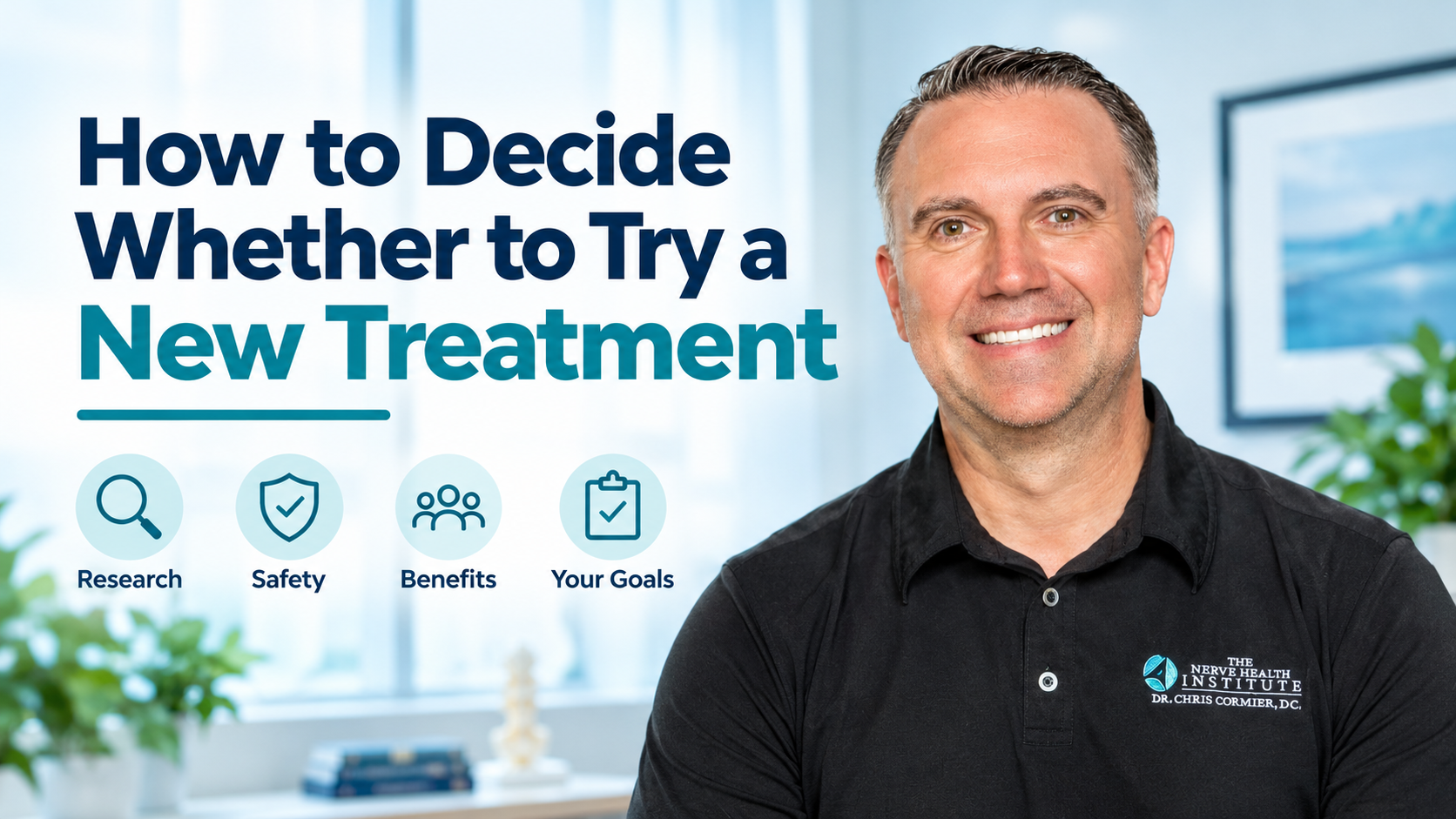
Then I added a therapy that puts an IV line in both of your arms. This is an essay about how that happened, and about the four questions I ended up using on myself — which I think are the right four questions for anyone deciding whether to try something new.
What a rule like that is actually for
Here is something I did not fully understand until I had to examine it.
A rule like “nothing invasive” is not a virtue. It is a filter — and a very good one, because it does its work without you having to think. It screens out an entire category before anything reaches your judgement, which saves you from a thousand individually tempting bad decisions.
The trouble with a filter that works that well is that you stop noticing it is a filter at all. You start experiencing it as an identity. And an identity is much harder to re-examine than a rule.
That is the part I want to be honest about. The hardest thing was not evaluating the therapy. It was noticing that I had stopped evaluating anything in that category years earlier.
The limit I kept arriving at
What forced the question was not enthusiasm. It was running into the same wall repeatedly.
My whole approach is built on replenishing what the body runs on — oxygen, water, light, then frequency, magnetism and nutrients. That works, and I will defend it all day.
But over enough years of doing it well, I kept noticing that replenishing is only half of a system. The other half is clearance. And blood is where both halves meet — it transports oxygen and nutrients to body tissues and returns waste, and it “distributes nearly everything that is carried from one area in the body to another.”
Everything, in both directions, through the same medium. Once I had that framed properly, the gap in what I was doing was obvious — and it had been obvious for a while, sitting behind a filter I had stopped looking through.
And then the part that is just embarrassing
I do not like needles.
That is a faintly ridiculous thing for someone in my position to admit, and I am admitting it because it is relevant. I was genuinely uneasy about my own first session, and I had to sit with the fact that some of my resistance was not principle at all. It was just nervousness wearing principle’s clothes.
Those two things are extremely hard to tell apart from the inside. I suspect that is true for most people facing most decisions, which is why the questions below are the ones I landed on — they are designed to work even when you cannot separate your reasoning from your reluctance.
The four questions
These are what I used on myself, and they are what I would want anyone weighing up anything — mine or anyone else’s — to use.
1. Is this solving something I actually have?
Not something impressive. Not something the marketing has convinced me I might have. Something I can describe in my own words before anyone describes it for me.
If you cannot state the problem without using the seller’s vocabulary, you have been sold a problem rather than offered a solution.
2. Who decides whether I am suitable — and will they say no?
This is the single most useful question on the list and almost nobody asks it.
If the answer to “who is this for” is “everybody,” walk away. A real assessment has a real possibility of ending in no — and a provider who screens you properly, and occasionally turns people down, is telling you something about their standards that no amount of marketing can.
A place that will tell you no is a place you can believe when it says yes.
3. What does this replace?
The right answer is nothing.
Anything presented as a substitute for care you are already receiving deserves immediate suspicion. So does anything positioned as a replacement for the unglamorous things — sleep, hydration, movement, breathing — because those are where most of the available ground genuinely is, and anyone telling you otherwise is selling against reality.
What you want is something that sits alongside what you are already doing and makes it easier.
4. What happens afterwards?
Anything done to you is a single event in an ongoing life. What you do in the weeks that follow determines most of what you keep.
If a provider has no view on that — if the conversation ends when the appointment ends — they are selling an episode rather than offering care. The question “what should I be doing between sessions” should have a real answer, and the person should be keen to give it.
Changing your mind in public
The questions got me to a decision. What I was not prepared for was how it feels to change a position you are known for.
Being consistent is comfortable. Being right is better, and it costs more.
There is a real pull toward holding a line simply because you have held it — especially when people have come to you precisely because of that line. Anyone who has built something around a principle knows this feeling.
What I would say to anyone in that position, in any field: the rule was not wrong. The rule did its job for decades. Having a high bar is not the same as having a closed door, and the bar is what makes it meaningful when something finally clears it.
I wrote a while ago about how the first brain I had to change was my own. This was the second time, and it was not easier for having done it once.
Where I landed
We now offer EBOO at the clinic — a supportive wellness therapy focused on circulation and oxygenation, run by an experienced nurse, with screening before anything is scheduled, and positioned as something that sits alongside the foundational work rather than in place of it.
If you want the detail, it is at EBOO Prime. The clinic itself, and the assessment work that most people actually start with, is at The Nerve Health Institute. And the free things that matter most — sleep, water, light, breathing — are on BodyCharger, where they have always been.
That order is deliberate, and it is the same order I would use for myself.
What I would actually ask of you
Not to try anything. To use the four questions on everything — including on me.
If something I offer cannot survive those questions, you should not do it, and I would rather you asked than assumed. The practitioners worth your time are the ones who get more comfortable as the questions get harder.
Frequently asked questions
How do I decide whether to try a new treatment?
Four questions. Is it solving something I actually have, in my own words? Who decides whether I am suitable, and is no a real possible answer? What does it replace — and the right answer is nothing. And what happens afterwards, because what you do in the following weeks determines most of what you keep.
What is the biggest red flag?
“It is for everybody.” Nothing is for everybody. A provider who screens properly and sometimes turns people away is telling you something about their standards that marketing cannot.
How do I know if I am being cautious or just afraid?
You often cannot, from the inside. I could not. That is exactly why the questions are useful — they work on the decision rather than on your feelings about it, and they give you an answer either way.
Why did you change your position on invasive therapy?
Because replenishing what the body runs on is only half a system, and I kept arriving at the same limit without a way past it. The rule had been doing its job for decades; the bar is what made it meaningful when something finally cleared it.
Should I start with something at home or in a clinic?
Home, almost always. The free things carry most of the available ground. Clinic work adds measurement and the things that need equipment, and it holds far better when the home side is in place.
If something here landed
Get in touch. More of how I think about this is in my writing, and the longer version of how I got here is on the about page.
Dr. Chris Cormier, DC
Lafayette, Louisiana
Clinic care at nervehealth.com. At-home protocols at bodycharger.com. Circulation and oxygenation at ebooprime.com.
Spark your cells to optimal longevity.