Almost everyone who sits down across from me with a rheumatoid arthritis diagnosis has already seen several doctors.
They are not confused about what they have. They can name the medications, quote their last inflammatory markers, and tell me exactly what their rheumatologist said. What they carry in with them is something else — a settled belief that this is now permanent, that the arc only points one way, and that their job from here is to manage the descent gracefully.
That belief is the thing I want to talk about, because after 27 years I have come to see the rheumatoid arthritis root cause question very differently from how it is usually framed. Not as an argument with rheumatology, but as a question about which layer you are looking at.
A Label Describes. It Does Not Explain.
A diagnosis is enormously useful. It gets you the right specialist, the right monitoring and the right medication, and I would never want a patient to be without one.
But a label describes a pattern of findings. It does not tell you why this person, why these joints, why starting in that particular year. Two people can share a diagnosis and have arrived at it by completely different routes, and I find those routes matter enormously for what can be supported afterwards.
So when someone tells me they have rheumatoid arthritis, my honest reaction is: understood, and now tell me about your life. Because that is where the route is.
How I Think About Autoimmunity
I should be clear that what follows is my working model, developed in clinic over nearly three decades. It is how I reason, not established immunology, and I would rather say that plainly than dress it up.
Here it is. Nobody is born with a perfect set of cells — we each start with roughly 30 trillion of them and whatever inheritance came with them. From the first day, life adds load, and cells under sustained load stop performing the way they should. My view is that when enough cells in a region are functioning badly, the immune response that follows is not a malfunction so much as attention being paid to a genuine problem.
Whether or not that framing turns out to be the full story, it changes what I do next. Instead of thinking only about calming the response, I go looking for the region that is struggling and ask what it needs. In practice that has been a productive question to ask, and it is the one conventional care has the least room to explore.
The Three Streams of Load
When I take a history, I am tracking three streams, and I weight them equally.
- Physical — accidents, injuries, surgeries, years of a job that asked the same thing of the same joint
- Emotional — loss, prolonged pressure, the stretch of life someone got through rather than recovered from
- Environmental — food, water, what meets the skin, what is breathed in day after day
None of these usually announces itself. They accumulate quietly, and the diagnosis arrives years downstream of the loading that shaped it. This is why I want the whole timeline rather than the last six months — and why patients so often go quiet partway through, because they are seeing their own life laid out in sequence for the first time and something obvious is sitting right there.
Why I Examine Function, Not Just Findings
Bloodwork and imaging tell you about chemistry and structure. Neither is designed to tell you whether signal is actually reaching the tissue around a joint.
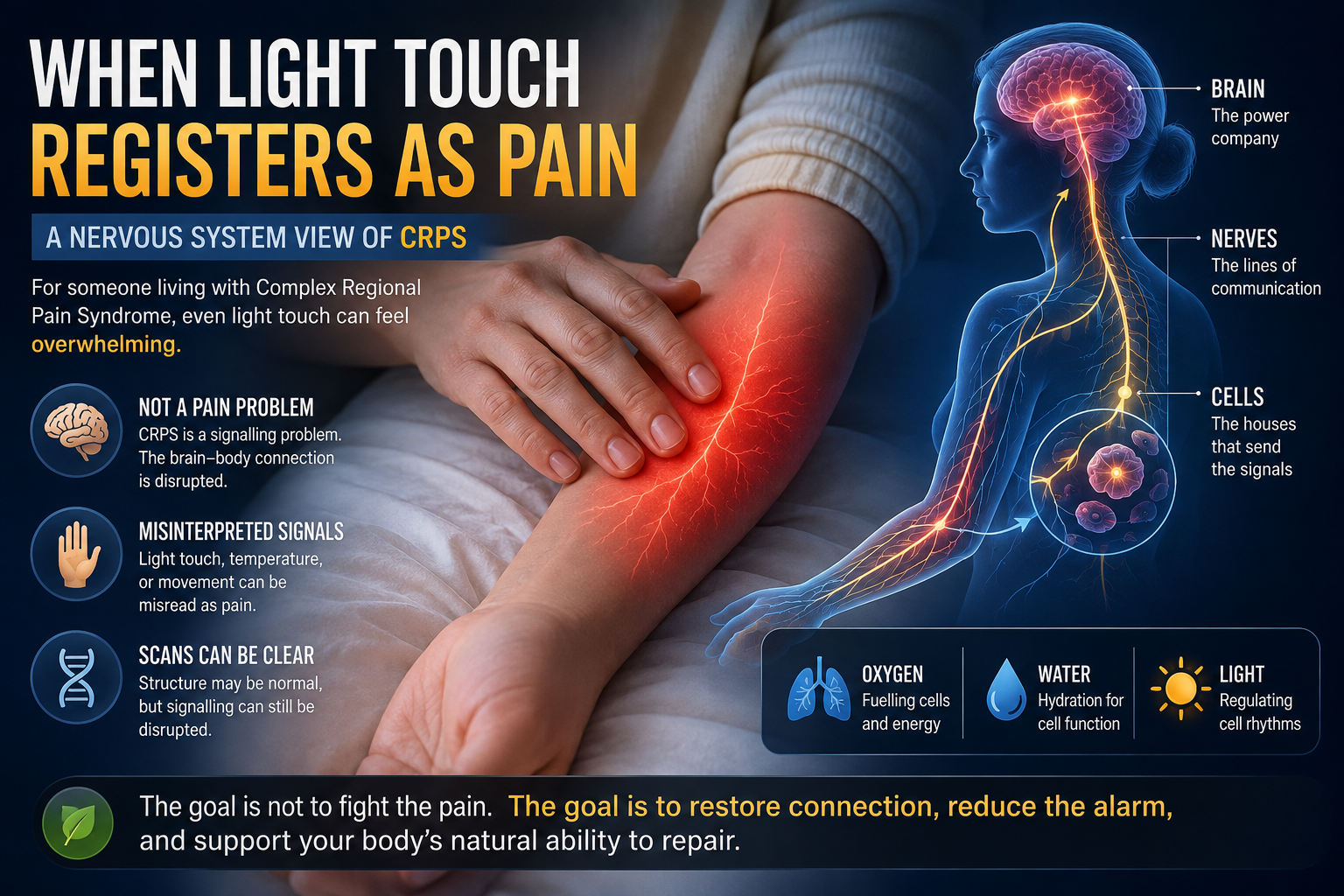
Every joint you have is wired back to the brain — the bone, the muscle, the connective tissue, all of it. There are 88 major nerves branching off the brain and spinal cord, and they carry that signal out to everything. I examine across all of them, region by region. It is closer to walking a breaker box than to asking whether the building has power.
That examination is where I most often find something nobody has looked at, and it is why patients describe the frustrating gap where the numbers improve and the body does not agree. Both readings are accurate. They are simply measuring different layers.
Why I Keep Coming Back to Frequency
Einstein suggested frequency would become central to medicine, and I think he was right earlier than most people realise.
Every tissue carries its own resonant frequency. The cells in one joint are tuned differently from the next, and differently again from heart or liver tissue. When tissue drifts under sustained load, it stops performing — the same way a guitar string that has gone flat still makes a sound, just not the right one.
What has changed in my practice is portability. For years frequency work meant clinic equipment. Now a good deal of it fits in a pocket, which means the work continues between visits instead of pausing until the next appointment. That shift is the reason I built BodyChargers — the clinic can only see so many people, and the daily foundations were always going to matter more than anything I do in a treatment room.
The Gumbo Problem
I use a Louisiana analogy for this more than I probably should.
If a gumbo is not right, you do not label it a permanently bad gumbo and serve it that way for the rest of your life. You taste it and work out what is missing. Sometimes it is one thing. Usually it is three or four small things that together were never going to produce what you wanted.
Cells work similarly. Oxygen, water, nutrients, signal from the brain, rest. Miss enough of them for long enough and the tissue underperforms, and no amount of relabelling changes what it needs. Add them back and tissue tends to do what tissue does.
What I Can Promise and What I Cannot
I want to be straight about this, because plenty of people in my field are not.
I cannot promise to reverse rheumatoid arthritis, and joint damage that has already happened does not undo itself. Where joints have deteriorated significantly, we may recover a good portion of function rather than all of it — and for someone who could not hold a coffee cup, that portion can change the shape of a day. But I would rather tell you that at the start than sell you something else.
I also cannot tell you what to do about your medication. That is outside my jurisdiction, and it belongs with the rheumatologist who has your labs and your imaging in front of them. Most people who find their way to me are already thinking about that question. My answer is consistently the same: have the conversation with your physician, keep your monitoring, and do not change anything based on an article.
What I can offer is the layer nobody has examined: where signal is running below capacity, what your history has been quietly loading onto your system, and what the daily foundations look like. In my experience that is where the room is — and for people who have been told there is nothing left to try, it is usually more room than they expected.
What I Tell People on a First Visit
Bring the whole story, not the summary. The detail you think is irrelevant is often the one that matters.
Expect a plan rather than a session. Rheumatoid arthritis responds to methodical, staged work, and the pace has to match where your system actually is. Pushing a body that is already running low produces guarding, not progress — which is why aggressive intervention so often backfires in exactly the people who most want fast results.
And expect to do most of the work yourself. The best outcomes I see are in patients who learn enough that they need me less over time. That is the goal, and I say so on day one.
Where I Would Start
If you are living with rheumatoid arthritis and this way of thinking lands with you, the first steps are not dramatic.
Keep a single line each day — pain, energy, sleep, stress. Within two months you will have a pattern, and patterns are actionable in a way that a general sense of “some days are worse” never is. Take it to your rheumatologist; they will get more out of your appointments too.
Then look hard at the foundations, because they set the ceiling for everything else: sleep rhythm, hydration, morning light, breathing, and movement matched to today rather than to the version of you from five years ago.
When you want to go further, BodyChargers covers the at-home methods and devices, and the Nerve Health Institute in Lafayette is where the full assessment and clinic technologies live.
The message I would want you to leave with is not that your diagnosis is wrong. It is that a diagnosis describes where you are, and there is more within your reach than you have probably been told.
Frequently Asked Questions
Is there really a root cause of rheumatoid arthritis?
Medicine describes rheumatoid arthritis as multifactorial — genetics, environment and immune activity together — rather than tracing it to a single cause, and that is a fair description. When I use the phrase, I mean something narrower: the accumulated load and the specific areas of reduced function in front of me in this particular person. That is workable, and it is usually unexamined.
Do you disagree with rheumatologists?
No. Rheumatology does something I do not do, and it does it well — diagnosis, disease monitoring and medication that protects joints over the long term. My work sits on a different layer. The patients who do best are the ones holding both, not choosing between them.
Should I stop my medication?
That is not my decision to make, and I would not want it to be. It belongs with the physician who has your labs and imaging. What I would say is that it is a conversation worth having openly with them rather than a decision to make alone or based on something you read online.
How long does this take?
Rheumatoid arthritis calls for staged, corrective work rather than a quick fix. Mild cases move faster. Advanced ones take longer and may have a ceiling set by existing joint damage. I would rather set that expectation at the start than have you measure progress against a timeline that was never realistic.
Can you help if I am not in Louisiana?
Much of the foundational work is location-independent, which is exactly why BodyChargers exists. The full 88-nerve assessment and the clinic technologies are in Lafayette, and patients do travel for that — but nobody needs to wait for a flight to start on the foundations.
What if my joints are already badly damaged?
Then I will tell you honestly what I think is available. Structural damage does not reverse, but function around a damaged joint often improves — range, strength, usability. For someone who could not grip a pen, that is not a small outcome.
Want to Go Deeper?
Start with the at-home methods, or book a full assessment at the clinic.
Explore BodyChargers → bodycharger.com
Visit the Clinic → nervehealth.com/get-treatment/