I am Dr. Chris Cormier, and I have been in practice for almost three decades. In that time I have sat with a great many people who arrived with Complex Regional Pain Syndrome and a folder of results that explained nothing.
If you are searching for a CRPS specialist, you have probably already been through several rounds of that. So rather than list credentials at you, I would rather tell you plainly how I think about CRPS — because if the way I look at it makes sense to you, that is a far better basis for working together than any qualification I could put after my name.
Why I Stopped Thinking of CRPS as a Pain Condition
Pain is what brings people to me. It is not what I spend most of my time thinking about.
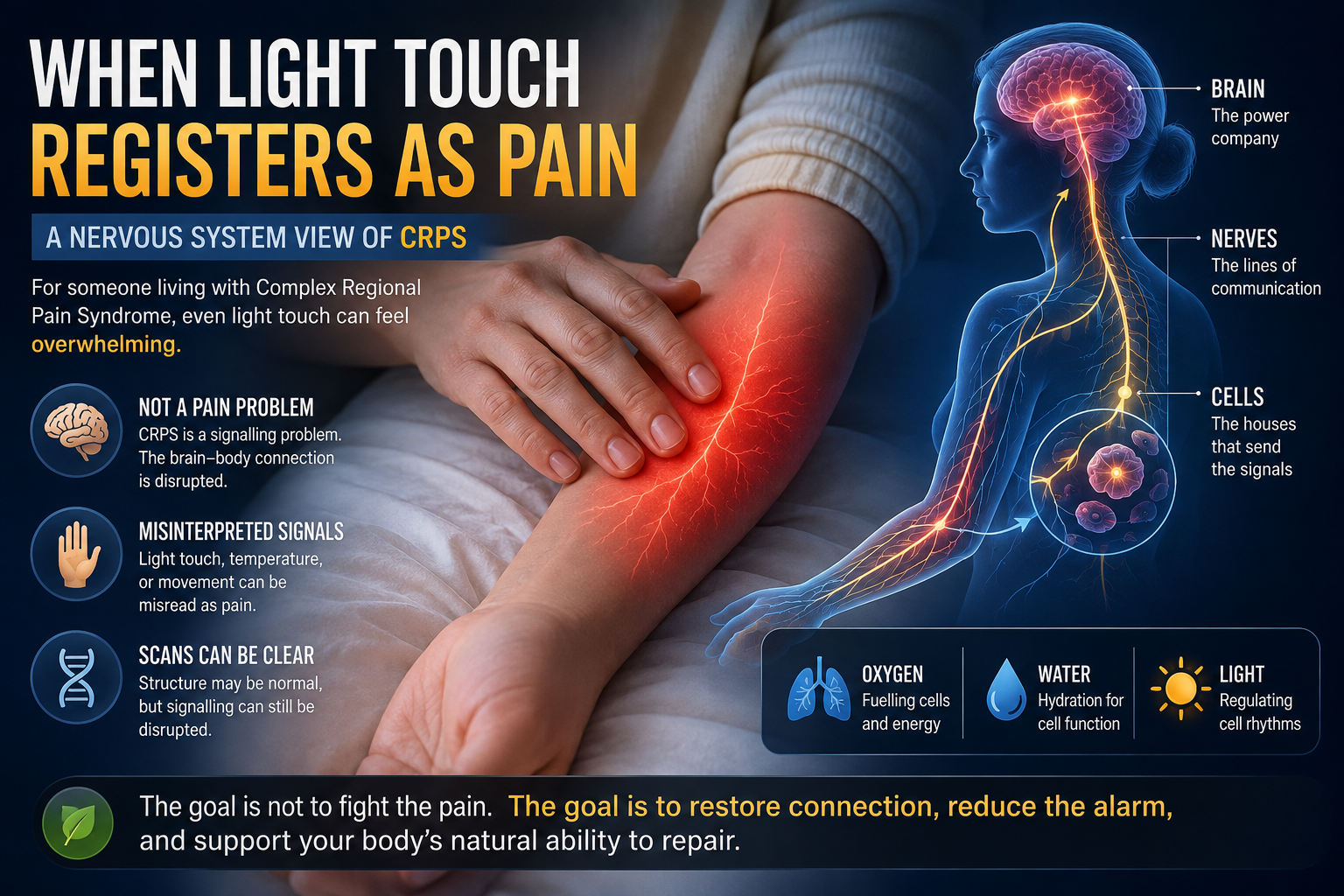
Here is the way I see it. Your brain is the power company. You have roughly 30 trillion cells, and every one of them is wired back to it. Nerves are the lines carrying that power. When the connection to a group of cells weakens, those cells do not simply go quiet — they start calling out that something is not right. Pain is one of the ways that call reaches you.
So when I meet someone with CRPS, the question I am asking is not how loud the pain is. It is where the connection has been lost, and what it will take to restore it. That single shift changes what you examine, what you measure, and what you do on a Tuesday afternoon with a person in front of you.
What I Look For That Tests Do Not Show
Most people arriving at my clinic have had imaging, and most have been told it is clear. I want to explain why that result and their experience can both be accurate.
There is an assumption that a nerve must be pinched to stop working properly. It is not so. I have seen plenty of pinched nerves conducting perfectly well, and plenty of unpinched nerves conducting poorly.
An MRI shows me the nerve. It does not show me the energy travelling along it. That flow is the thing I care about, and it is invisible to the scan. So a clear image tells you the structure is intact. It does not tell you the communication is.
This is why I examine connection directly. There are 88 primary nerves coming off the brain and spinal cord — the major power lines — and because I know the route and the job of each one, I can assess flow pathway by pathway and give you a percentage. It turns something vague into something specific, and it gives us a number to measure progress against.
The Question I Am Asked Most: Is It In My Head?
Almost everyone with CRPS has been asked some version of this, and I want to answer it directly. No, it is not.
What is happening is a signalling problem, and it is a real one. Sensation travels from your body to your brain as input. When that channel is working well, something sharp registers as sharp within milliseconds. When it is not, interpretation goes wrong — and it goes wrong in ways that sound impossible if you have not seen them. I have put something sharp on a patient who did not register it as sharp at all. I have seen warmth reported as cold. I have seen the lightest touch arrive as severe pain.
None of that is imagination or exaggeration. The nervous system is reporting faithfully on information that is arriving distorted. Once you understand it that way, the person stops being the problem to be explained and the signalling becomes the thing to work on.
Why the Pain Can Spread, and Where the Opening Is
You have two sides to your nervous system. The parasympathetic side is where repair, digestion and rest happen. The sympathetic side handles survival — alertness, vigilance, alarm.
Repair happens on the parasympathetic side. So when someone has been in pain for a long time without answers, the system tends to sit in sympathetic dominance, and repair capacity falls while it does. That is the loop people feel as spreading or intensifying.
I find this genuinely encouraging rather than the opposite, because the loop has a handle on it. If I can identify which parasympathetic pathways are underactive and work on bringing them back, I am giving the repair side of your system room to do what it is built to do. That is a great deal more useful than waiting for a system in survival mode to somehow settle on its own.
Why I Work Slowly With CRPS
People who come to me with severe CRPS have usually had a hard time of it — needles, procedures, examinations that hurt. Many of them are wary of clinicians in general by the time they reach me, and I do not blame them for that.
So I do not push. Everything is graded. We begin well below the threshold that provokes a reaction and build tolerance in small steps, letting the nervous system discover that input can arrive safely. I have met people where they were comfortable rather than where a schedule said they ought to be, and I would do it again — the point is to work at the pace your system will actually accept.
It is a patient way of working. It is also why it suits people who have not found many gentle options.
Oxygen, Water and Light
Alongside connection, cells need their ingredients. I put them in this order deliberately.
Oxygen. The first ingredient, and the one most people are quietly short of. Shallow breathing over years leaves groups of cells running on less than they need.
Water. Quantity and quality both. More cellular function depends on hydration than people realise.
Light energy. The flow travelling from brain to cell along the nerve — the part that does not appear on any scan and the part my work centres on.
Frequency sits alongside these. Every cell has its own resonance, rather like each string on a guitar having its own note, and sustained stress can pull cells out of tune. I use frequency-based devices in clinic to support cells back toward proper resonance, and portable devices so that work continues at home between visits.
🎥 Watch: My Full Conversation on CRPS
I go through all of this in detail here — the brain-to-cell connection, why signalling goes wrong, and how I approach someone who cannot yet tolerate being touched.
What I Will and Will Not Tell You
You deserve straight answers from anyone you are considering working with, so here are mine.
I will not tell you what your result will be. Every person is different and yours will be your own, and anybody promising you a specific outcome before examining you is telling you what you want to hear. What I will tell you is exactly what I find when I assess your connection, what I think is achievable in your case, and if I do not believe I am the right person to help you.
I also work alongside your existing care rather than in place of it. Your medical team stays where it is, and anything to do with prescribed medication belongs with the person who prescribed it. Coming earlier gives me more to work with — but it is always worth asking, whatever stage you are at.
What Becomes Possible
This is the part I would want you to hold on to.
When connection between brain and cells improves, the repair side of the nervous system comes back into play, and it is remarkably capable once it has the resources. Cells that were signalling distress have less to signal about. Sensation starts being interpreted correctly again — pressure as pressure, warmth as warmth.
Your body is designed to repair itself. Think about an ordinary cut: where the cells are healthy it closes over without you doing a thing, and we all take that for granted. That capacity is built into you. My work is about restoring the conditions that let it operate.
Questions People Ask Me
How do I know whether you are the right CRPS specialist for me?
Come and find out. The assessment tells us both something concrete, and if I do not think I can help you I will say so rather than start a plan.
I cannot tolerate being touched. Can I still be assessed?
Yes, and this is common with CRPS. Everything is graded around your threshold rather than through it, and we go at whatever pace your system accepts.
What causes CRPS to start after something minor?
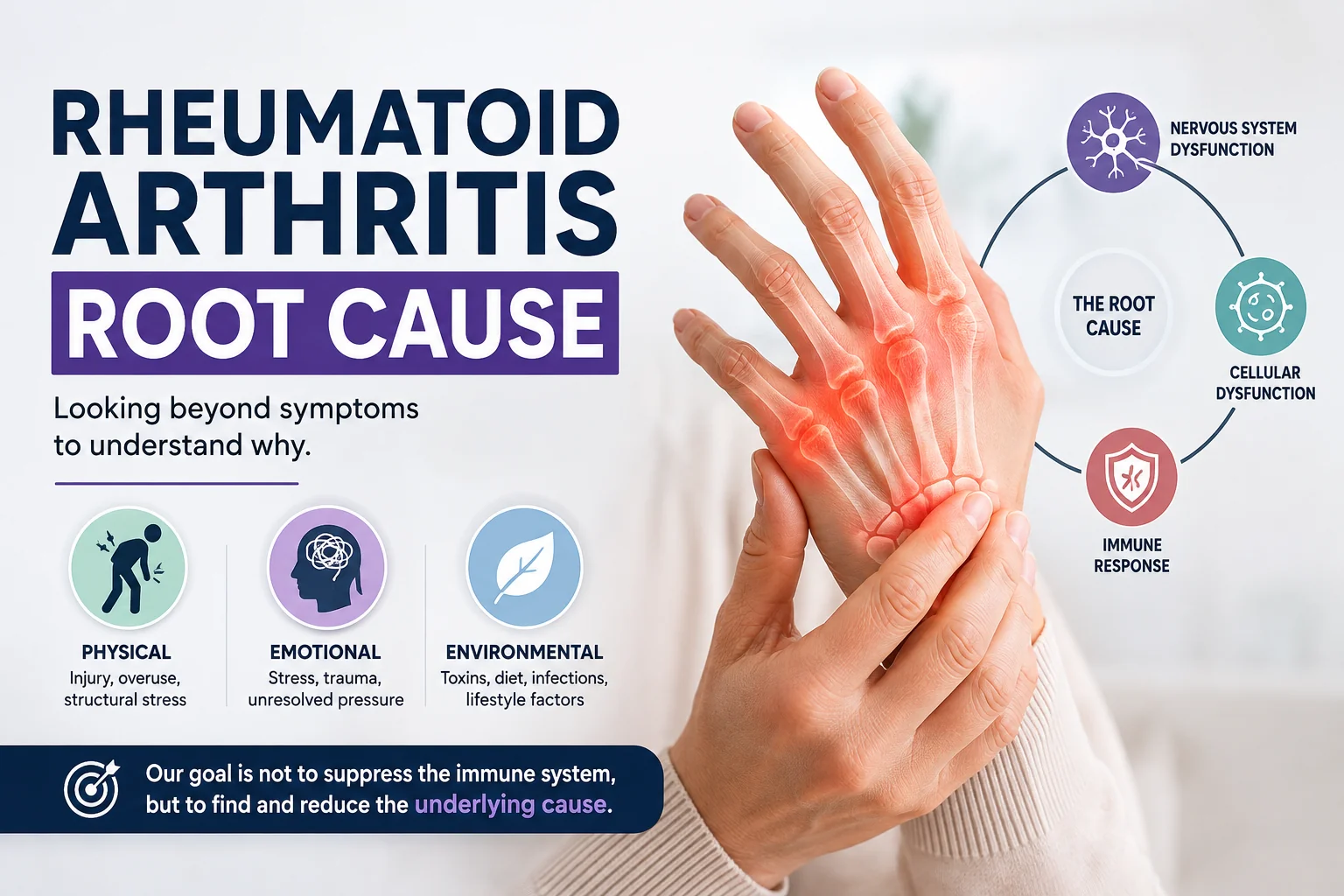
Cells are weakened by three categories of stress — emotional, physical and environmental — and they accumulate quietly. A modest injury can be the point at which an already-loaded system tips, which is why trigger severity and symptom severity so often do not match.
Do I need to stop my current treatment?
No. I work alongside your existing care, and changes to prescribed medication stay with your prescriber.
Do you take new CRPS patients?
Yes, though only a limited number each month, so it is worth enquiring early.
Is there anything I can do from home?
Yes. Bodychargers is the online platform where I have put my methods, tools and daily practice for use at home, and portable frequency devices support the work between visits.
If This Way of Thinking Makes Sense to You
Then the next step is an assessment that looks at connection rather than at pain alone, and an honest conversation about whether I am the right fit for your situation.
Nerve Health Institute — 108 Republic Ave. Ste. B Lafayette, LA 70508
· +1(337)456-6555 · https://nervehealth.com/get-treatment/
Spark your cells to optimal longevity.
— Dr. Chris Cormier